
The SEO industry is full of misinformation and lies that many business owners believe. Shortcuts and cheats do not work and should not be part of your SEO strategy.
The truth is, the SEO industry is filled with brilliant strategists, but it is also crowded with lies from snake-oil salesmen selling “shortcuts” that haven’t worked since 2010. Following this outdated advice doesn’t just waste your money; it can actively harm your business, getting your website penalized or de-indexed entirely.
Google is not a dumb machine anymore. With the introduction of advanced AI systems like RankBrain and SpamBrain, Google effectively reads your website like a human would. It can smell blackhat tricks from a mile away.
Here are 12 dangerous SEO lies business owners still believe, and the truth behind why they fail.
SEO Lie #1: “SEO is a One-Time Task (I Did It When I Built the Site)”
This is perhaps the most pervasive myth. Many business owners believe that SEO is something you “install” like a plugin or a fresh coat of paint. You launch the website, checking the “SEO” box, and assume you will rank forever.
Why It’s a Lie: The internet is a race, not a statue. Every single day, your competitors are publishing new articles, optimizing their pages, and earning new reviews. If you stand still, you are effectively moving backward. Furthermore, Google constantly updates its standards. What worked to rank your site in 2012 might be considered “thin content” today.
The Google Reality: Google releases Broad Core Updates several times a year. These updates reshuffle the rankings based on new quality standards. If your site hasn’t been touched in two years, these updates may slowly push you off page one in favor of websites that are demonstrating they are active, relevant, and current. Freshness is a signal; silence is a sign of a dead business.
SEO Lie #2: “I Can Guarantee You the #1 Spot on Google”
If an agency or freelancer tells you this, hang up the phone. Run. This is the hallmark of a scam.
Why It’s a Lie: No one—absolutely no one—has a “special relationship” with Google. Search rankings are determined by an algorithm with hundreds of variables, many of which change daily. Search results are personalized. If you search for “best pizza” while standing in downtown Toronto, you will see completely different results than someone searching from North York. There is no single “#1 Spot” that everyone sees anymore. This is especially true for local keywords
The Google Reality: Google’s own Official Guidelines explicitly state: “Beware of SEOs that claim to guarantee rankings, allege a ‘special relationship’ with Google, or advertise a ‘priority submit’ to Google.” A legitimate expert will promise growth, traffic, and leads overtime, but they will never promise a specific rank for a specific keyword.
SEO Lie #3: “More Keywords = Higher Rankings” (Keyword Stuffing)
“I want to rank for ‘Best Plumber,’ so let’s put ‘Best Plumber’ in every sentence.” This strategy, known as keyword stuffing, is a relic from the 90s that refuses to die.
Why It’s a Lie: Writing “We are the best plumber in Toronto because our best plumber services offer the best plumber rates” makes you look illiterate. It ruins the user experience. If a human finds your text annoying to read, Google will find it annoying to rank.
The Google Reality: In 2011, Google released the Panda Update, which specifically targeted low-quality content and keyword stuffing. Later, the Hummingbird Update (2013) introduced “semantic search,” meaning Google understands the context of your page. It knows you are a plumber even if you don’t repeat the word 50 times. It reads for meaning, not just for matching words. That being said, including your focus keyword in your headings is still a valid strategy but do not overdo it, especially in your content.
SEO Lie #4: “Buying Links is a Fast Track to Authority”
You might stumble upon services like “5,000 Backlinks for $50.” It sounds like a steal. If links are votes of confidence, surely more votes are better?
Why It’s a Lie: In the world of SEO, quality crushes quantity every single time. Buying thousands of links from “link farms”—websites created solely to link out—looks incredibly suspicious. It’s the digital equivalent of stuffing the ballot box. These backlinks actively hurt websites and can trigger penalties with Google and other search engines. Often these penalties take years to recover from and sometimes sites don’t recover at all and need to start fresh with a new domain.
The Google Reality: The Penguin Update (2012) was a game-changer that penalized sites for buying unnatural links. Today, Google uses an AI system called SpamBrain to detect and nullify these bought links. In a best-case scenario, Google just ignores them, and you wasted your money. In a worst-case scenario, you receive a “Manual Action” penalty and get removed from search results entirely. One link from a local Chamber of Commerce or a respected industry blog is worth more than 10,000 spam links.
SEO Lie #5: “Long-Form Content Always Ranks Higher”
There is a belief that every blog post needs to be a 3,000-word “Ultimate Guide” to rank. Business owners force their writers to fluff up simple topics with unnecessary backstory.
Why It’s a Lie: If a user asks, “How to tie a tie,” they want a diagram and 100 words of instruction. They do not want a 2,000-word history of the necktie dating back to the 17th century. Forcing length for the sake of length creates a bad user experience.
The Google Reality: The Helpful Content Update (2023) was a direct attack on content written for search engines rather than humans. Google explicitly stated that they prioritize content that satisfies user intent. If you can answer the question perfectly in 300 words, that is better than a 3,000-word page full of fluff.
SEO Lie #6: “AI Content Can Fully Replace Human Writers”
With the rise of ChatGPT, many businesses fired their writers and started publishing hundreds of AI-generated articles a day. “It’s free content!” they rejoiced.
Why It’s a Lie: Unedited AI content is often repetitive, generic, and lacks real-world expertise. It hallucinates facts and uses a vanilla tone that users find boring. If everyone is using the same AI to write the same “Top 10 Tips,” the internet becomes flooded with identical noise.
The Google Reality: In the March 2024 Core Update, Google cracked down on what they call “Scaled Content Abuse”—churning out mass amounts of low-quality content just to manipulate rankings. While Google doesn’t hate AI, it hates low-effort content. You need human expertise, personal stories, and unique insights (what Google calls E-E-A-T: Experience, Expertise, Authoritativeness, and Trustworthiness) to rank well. AI is a tool, not the pilot. The outline of this article was written by AI and then edited by me!
SEO Lie #7: “Spending Money on Google Ads (PPC) Boosts Organic Rankings”
“If I pay them for ads, they’ll be nice to me and rank my free listing higher.” It’s a common conspiracy theory.
Why It’s a Lie: Google maintains a strict wall between its advertising team and its search algorithm team. Paying for Google Ads gets you in the “Sponsored” section, but it does absolutely zero for your organic ranking below it. Your organic ranking positions will be unaffected by Google Ads.
The Google Reality: Google’s Search Liaison, Danny Sullivan, has confirmed this countless times. There is no “pay-to-play” for organic search. However, running ads does give you data. You can see which keywords convert into sales, and then use that knowledge to improve your SEO strategy. The act of paying itself buys you no organic traffic.
SEO Lie #8: “Domain Authority (DA) is a Google Ranking Factor”
You may hear SEO agencies say, “We need to get your DA from 20 to 30.”
Why It’s a Lie: Domain Authority (DA) is a metric invented by Moz, a software company. It is not a Google metric. Semrush has “Authority Score,” Ahrefs has “Domain Rating.” These are all third-party guesses at how authoritative your site is. Google’s search algorithm leak in 2024 did indicate they have their own metric for calculating an equivalent version of DA, but its intricacies were not published.
The Reality: You can rank #1 on Google with a low “DA” if your content is better than the competition. Obsessing over a third-party score is like trying to impress a movie critic who doesn’t work for the Oscars. It’s a helpful benchmark, but it’s not the goal.
SEO Lie #9: “Social Media Shares Directly Improve Rankings”
“If this post goes viral on Facebook, my website will shoot to #1 on Google.”
Why It’s a Lie: Google does not use Facebook likes or Twitter shares as a direct ranking factor. Most social media pages are “walled gardens”—Google’s crawlers cannot always see who liked or shared a post due to privacy settings. However, public posts to some platforms like Instagram can rank and Google will use the transcript in those videos for things like meta descriptions and title tags when deciding to rank them.
The Reality: Social media is powerful, but its effect is indirect. If your post goes viral, more people see your brand. Some of those people might run a blog and link to your website. That link helps you rank. The likes themselves? They are vanity metrics for SEO purposes.
SEO Lie #10: “LSI Keywords Are Magical Secret Codes”
Some gurus will tell you that you must use “LSI Keywords” (Latent Semantic Indexing) to unlock Google’s algorithm. They sell tools that generate lists of related words you “must” include.
Why It’s a Lie: LSI is an ancient natural language processing technology patented in the 1980s. It was designed for small, static databases, not the massive, changing internet.
The Google Reality: Google’s John Mueller has explicitly said, “There’s no such thing as LSI keywords for SEO.” Google uses much more advanced neural networks (like Neural Matching) to understand language. You don’t need a tool to tell you to use the word “faucet” when writing about “sinks.” Just write naturally. If you know your topic, you will use the right words automatically.
SEO Lie #11: “Domain Age is Everything (New Sites Can’t Rank)”
“My competitor has been online since 2005; I can never beat them.” We hear this all the time in the SEO space, and it couldn’t be further from the truth. We’ve seen and ranked dozens of brand new sites in less than a week . Content is king, domain age plays a very small role.
Why It’s a Lie: While older sites often have more backlinks (which helps), age itself is not a shield. Many old sites are full of broken code, outdated information, and slow design.
The Reality: A brand-new site that is fast, mobile-friendly, and has incredible content can absolutely outrank a 20-year-old dinosaur that hasn’t been updated since the Flash era. Google cares about who is the widely relevant today, not who bought their domain first.
SEO Lie #12: “You Don’t Need to Worry About Technical SEO If Content is Good”
“I’m a writer, I don’t do code. If the story is good, people will come.”
Why It’s a Lie: You can write the best article in the world, but if Google’s robots cannot crawl your website because of a technical error, you do not exist. If your site takes 10 seconds to load on a an iPhone, users will leave before reading a single word. If your canonical URL points users to another page, that page likely won’t rank. The same applies for pages that are missing from your website’s XML sitemap.
The Google Reality: With the Page Experience Update, Google made Core Web Vitals (speed, responsiveness, visual stability) an official ranking factor. Technical SEO is the foundation. You cannot build a penthouse (great content) on a swamp (bad code).
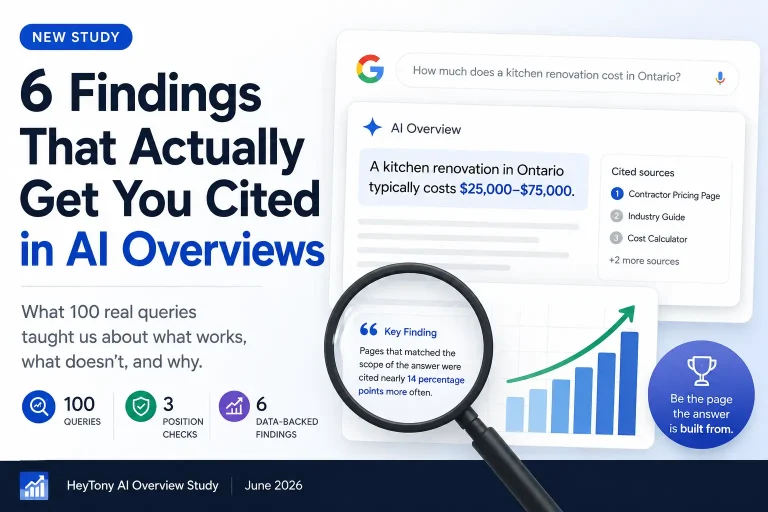
The newest batch of lies is about AI search. Before you pay anyone for “AEO services,” read what we found testing 100 AI Overviews, because half the citations those tools report are flukes.
The Boring SEO Strategies Work Best
The reason these lies persist is that the truth is boring. The truth is that good SEO is long term work. It requires understanding your customers, writing content that genuinely helps them, ensuring your website is technically sound, and earning authority over months and years.
The reason these lies persist is that the truth is boring. The truth is that good SEO is long term work. It requires understanding your customers, writing content that genuinely helps them, ensuring your website is technically sound, and earning authority over months and years. There are no cheat codes. There are no secret buttons. But the good news is that because so many of your competitors are chasing these lies and shortcuts, you can beat them simply by doing the work that actually matters and helps your customers. If you’d rather have experts handle the strategy and execution, you can explore our professional SEO services to see how we help businesses grow their organic traffic.
Originally published . Last updated .
Categories:

Explore More