
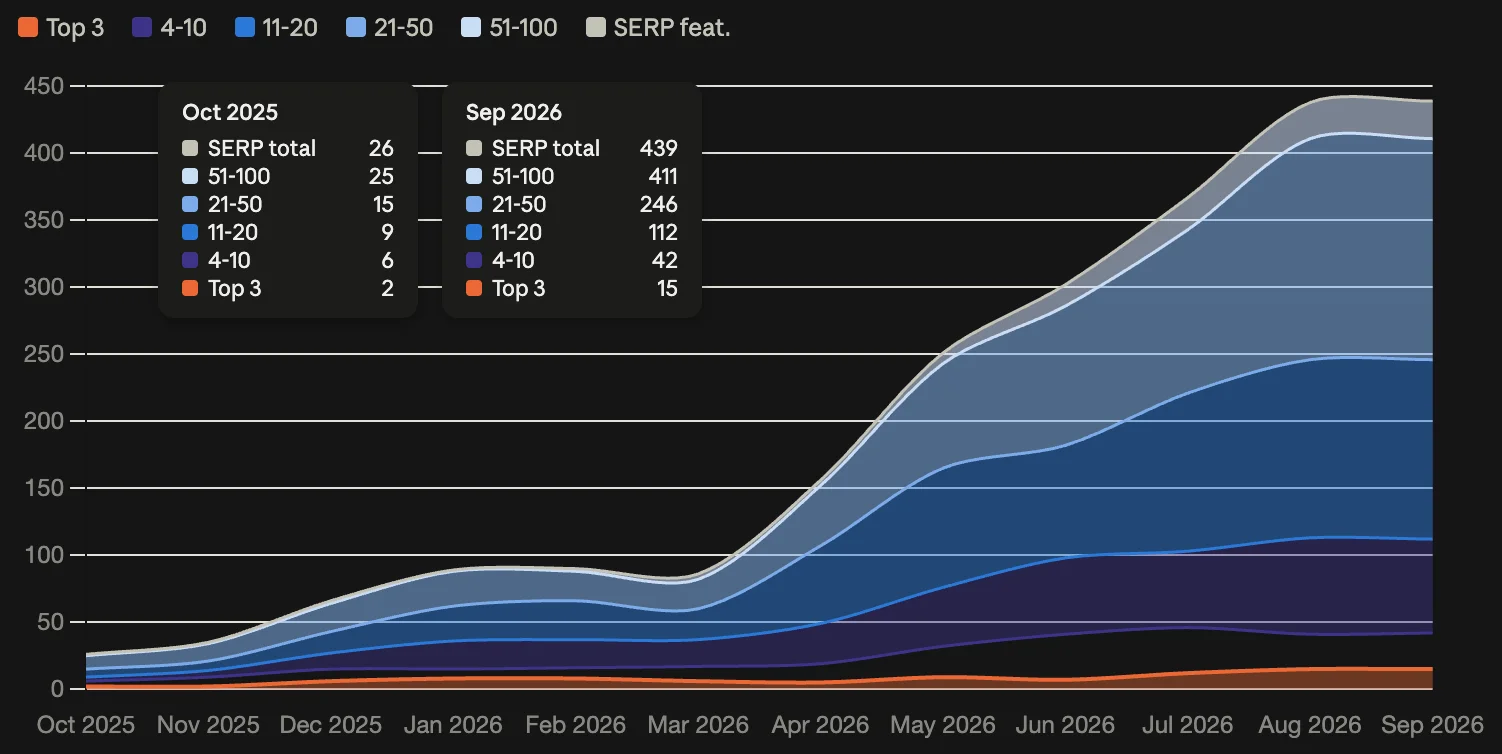
Client details have been changed for privacy. Performance data is unmodified.
When Veltura Media came to HeyTony for SEO services, Google barely knew they existed, at least not to anyone who wasn’t already searching for them by name. Just 25 keywords ranked, almost all branded, and the site pulled in next to no organic visibility beyond people who already knew them.
When auditing their site, it was easy to see why: we found only service pages with generic website copy and a blog page with no real content. It looked like a marketing company that existed, but not one actively answering the questions and queries its future clients were searching for on Google.
Our goal was to build the client a sustainable pipeline of non-branded, commercial-intent traffic. Instead of only being found by people who already knew their name, they’d start showing up in front of the audience actively searching for the services they offer. We achieved this goal, increasing the number of keywords the client ranked for by 1,656% and clicks by 169%. See how we did it below.
What We Did
Rather than chasing quick wins, we approached the rebuild in four deliberate phases, each one building on the last to move the client from near-invisible to a genuine authority in front of the audience that mattered most.
Phase 1 — Built Topical Authority
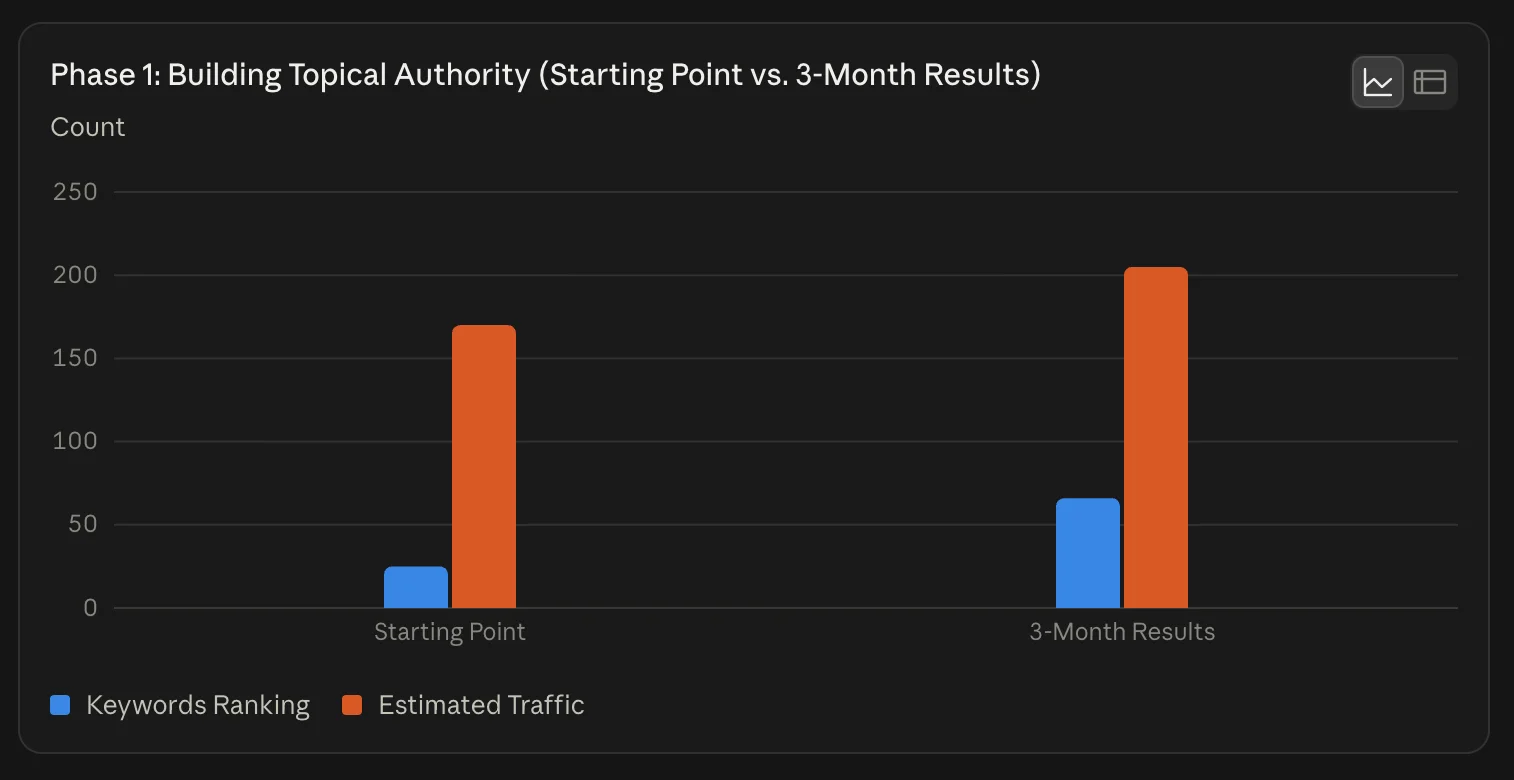
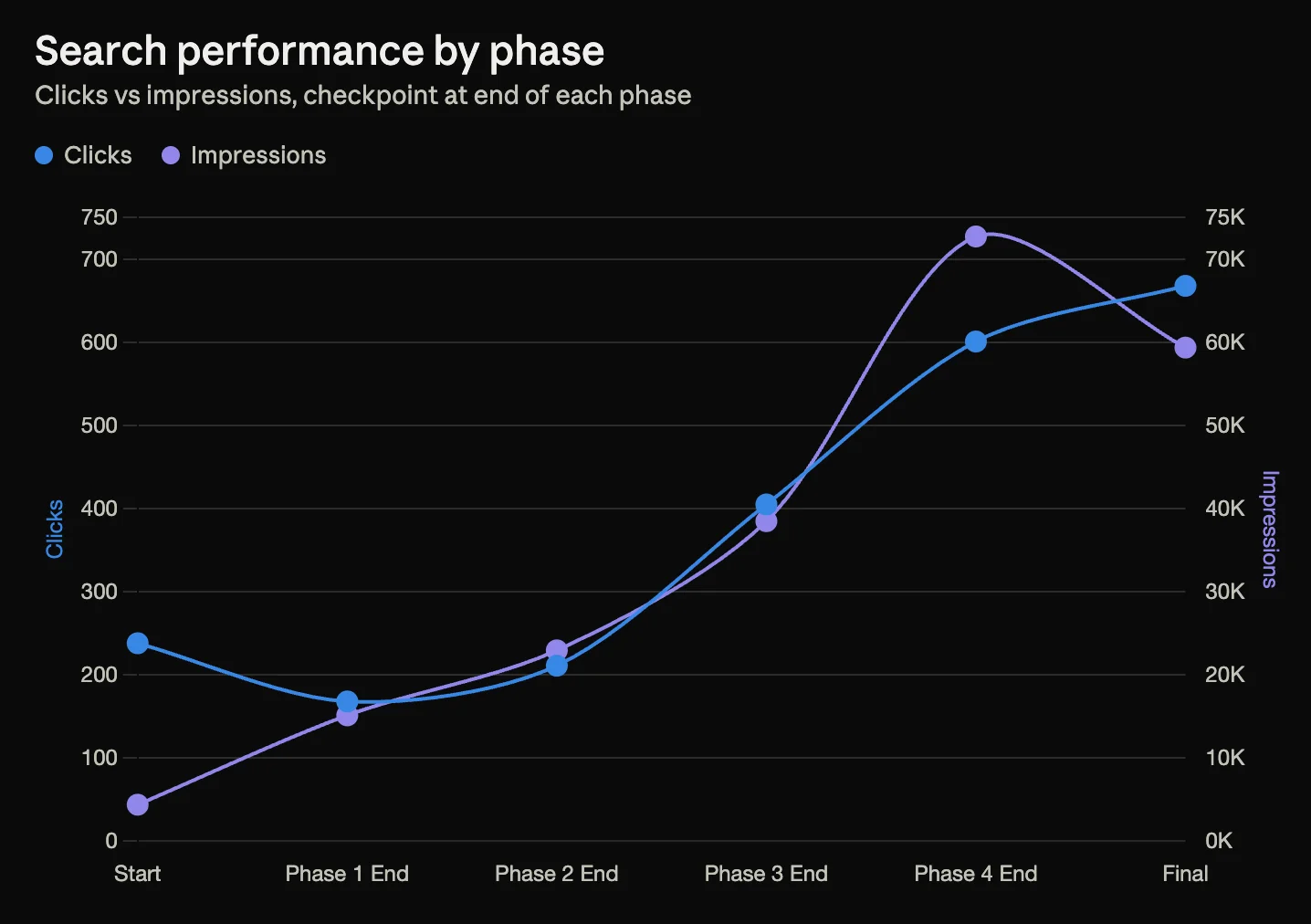
Starting point: 25 keywords ranking, ~170 estimated traffic, ~$1 traffic cost, impressions averaging 100–150/day.
We built topical authority through informational content: how-to guides, tactic and strategy round-ups, industry-idea articles, and term-explainer content with concrete examples. We covered all the core topics in their industry, created helpful content that answered questions thoroughly, and began linking all content to key service pages to drive conversion.
Why? Google ranks sites that show broad, genuine expertise on a topic, not just a few isolated pages. The site had no topical depth to begin with, and Google treats thin, low-value content as a ranking liability. Informational content fixes that: it builds the breadth and credibility Google needs before it will trust the site for competitive commercial keywords (Phase 3). It also provides the depth signal AI overviews/search tools now reward.
Internal links help Google find, crawl, and understand relationships between pages. They signal which pages matter most, pass ranking value between pages, and help users navigate to related content, reinforcing topical authority instead of leaving pages isolated.
3-month results: 66 keywords ranking, ~205 estimated traffic, $455 in traffic cost, impressions averaging 400–700/day.
Phase 2 — Strengthened Core Service Pages
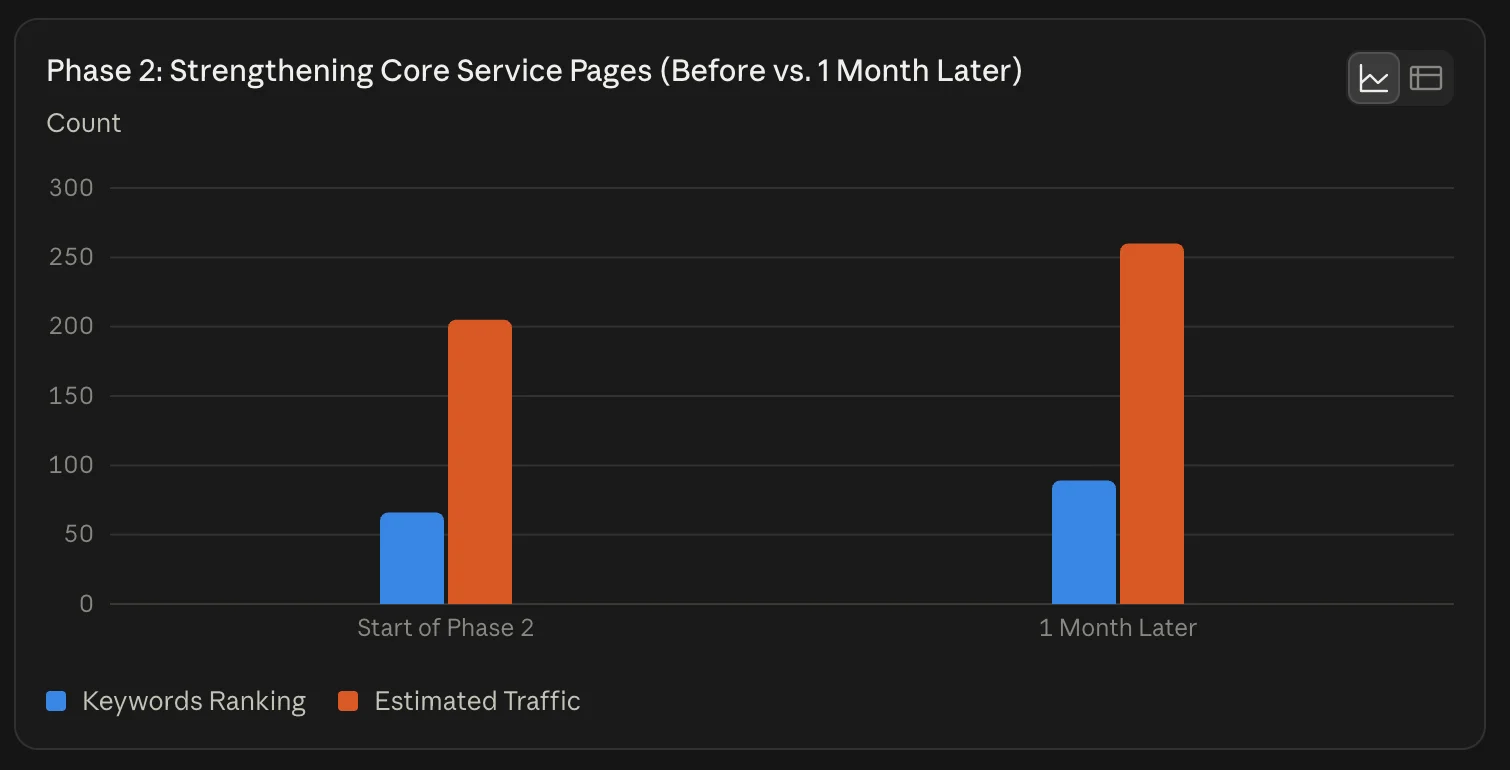
Once we built topical authority, we updated the client’s key service pages, each targeting a specific primary keyword, and expanded content depth to genuinely help searchers and compete with and outperform competitor pages ranking for the same terms.
Service pages are where commercial intent lives; that’s where visits turn into leads. But Google ranks pages relative to competitors, not in isolation: a thin page loses to a more thorough one on the same keyword. Expanding depth and specificity gives these pages a real shot at outranking competitors, and it converts the topical authority built in Phase 1 into rankings on the pages that actually drive business.
1 month later: 89 keywords ranking, ~260 estimated traffic, with impressions and clicks fluctuating but still trending upwards.
Phase 3 — Shift Toward Conversion Intent
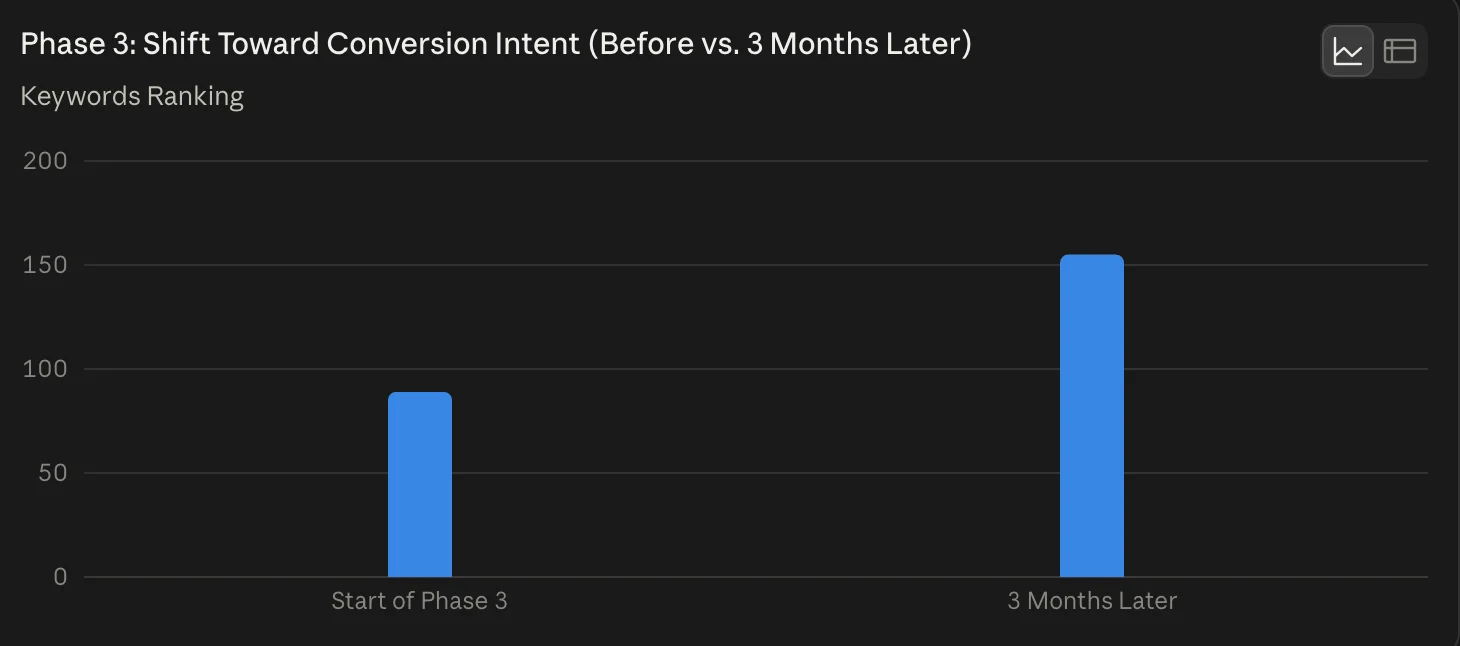
We continued building topical authority but shifted focus to bottom-of-funnel, transactional/commercial-intent keywords and began building new dedicated landing pages for the various sub-services the client offers.
Top-of-funnel and informational keywords bring visitors, but they’re often just researching, not ready to buy. Bottom-of-funnel, transactional keywords are what people search right before they hire or purchase, so ranking for them drives leads, not just visits.
Dedicated landing pages per service line matter because a single generalized page can’t target the specific intent behind each service. Splitting them lets each page match a searcher’s exact need, which improves both rankings and conversion rates.
3 months later: 156 keywords ranking, ~$1K in traffic cost, impressions in the thousands, clicks averaging 10-15/day.
Phase 4 — Seasonal Relevance + AI/LLM Visibility
We layered in time-sensitive/seasonal content tied to recurring calendar events relevant to their industry. We also began applying on-page strategies to improve visibility in AI-generated answers (Google AI Overviews and similar LLM-driven search features).
3 months later: 367 keywords ranking, averaging 20-30 clicks per day, with 3,050 cumulative clicks and 289,000 cumulative impressions since the start of the engagement.
Continuing the BOFU and new-landing-page strategy, we added another 1,210 clicks and 111,000 impressions in the following two months.
Overall Results for Veltura Media
Rankings & Visibility
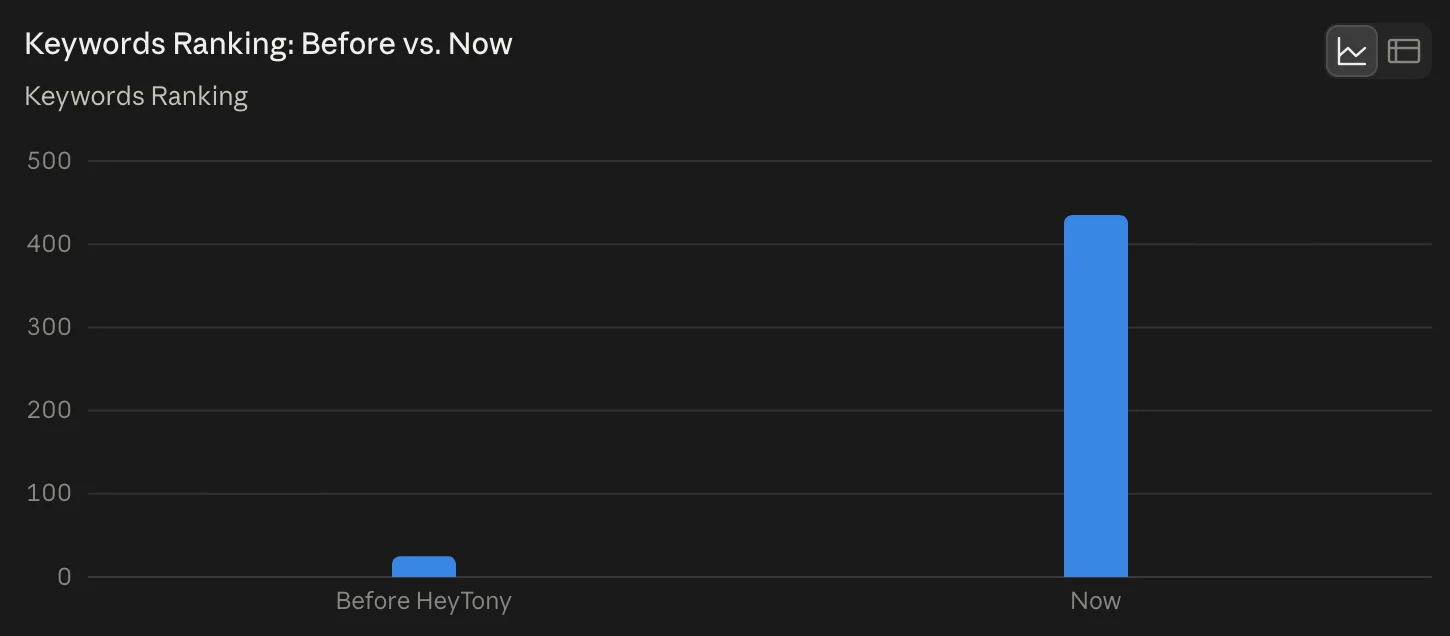
- Veltura Media now ranks for 439 keywords vs. 25 keywords when they started with us,
- Their average position before starting with us was 20, and is now 15 across all site pages.
- 94% of current organic traffic comes from non-branded search terms, confirming the growth reflects genuine topical/discovery visibility, not just people searching the company’s name.
Organic Traffic Growth
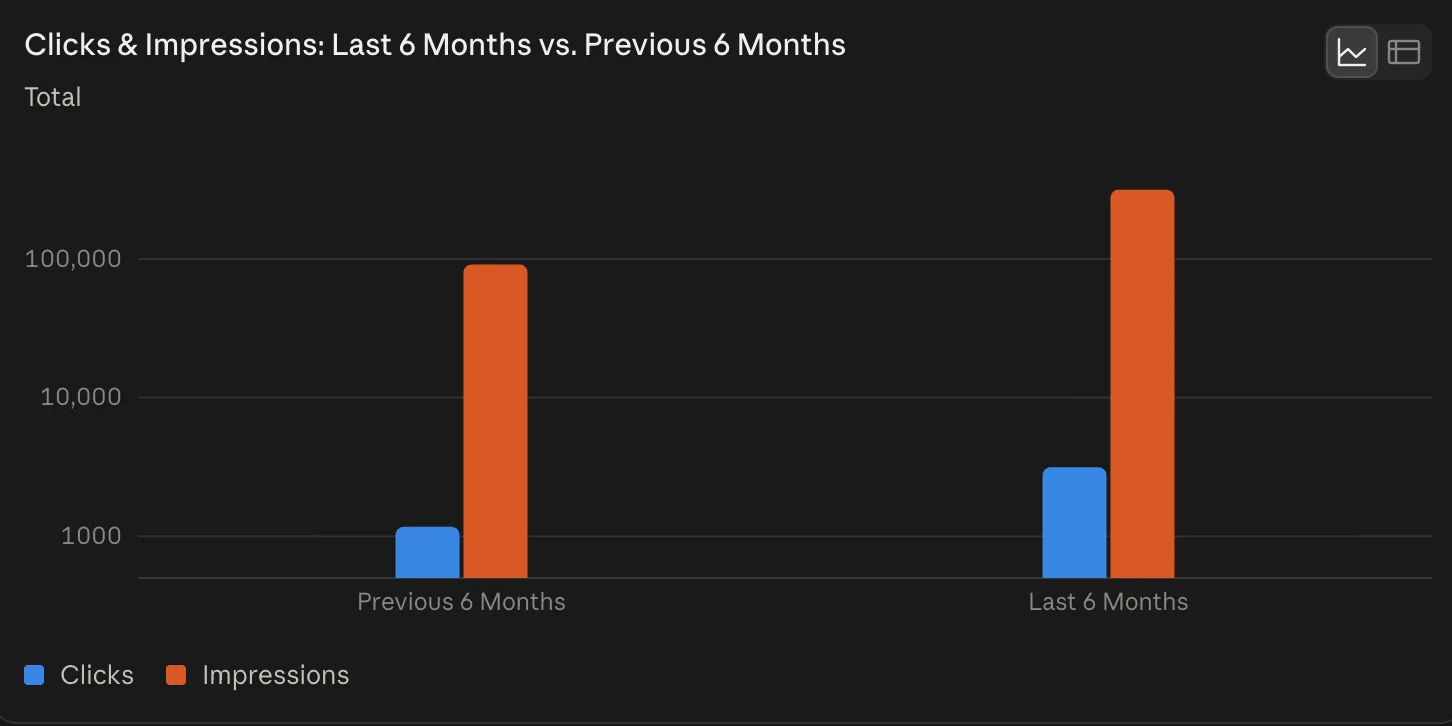
- Before working with us, Veltura Media averaged roughly 219 clicks and 2,875 impressions per month. Since partnering with us, that’s grown to roughly 362 clicks and 34,083 impressions per month; about 65% more clicks and nearly 12x more impressions, on average, each month.
- Organic clicks grew 169% comparing the most recent 6 months to the prior 6 months, from ~1,170 to ~3,150 clicks. Impressions grew 247% over the same comparison, from ~91,300 to ~316,000 impressions.
- Over the last 3 months specifically, clicks reached 1.87K (+46% vs. the prior 3 months), and impressions reached 191K (+53%).
- The site recently hit a Google Search milestone, reaching 600 clicks in 28 days.
AI/LLM visibility
- Pages cited as sources in AI-generated search answers grew from a baseline of 2 to 25, jumping from almost no AI-search footprint to a meaningful one.
- On Bing (including LLM-driven traffic), impressions climbed to 60.8K (+1,463% year-over-year), clicks reached 694 (+100% YoY), and LLM sessions reached 52 (+643% YoY).
Backlinks & Referring Domains
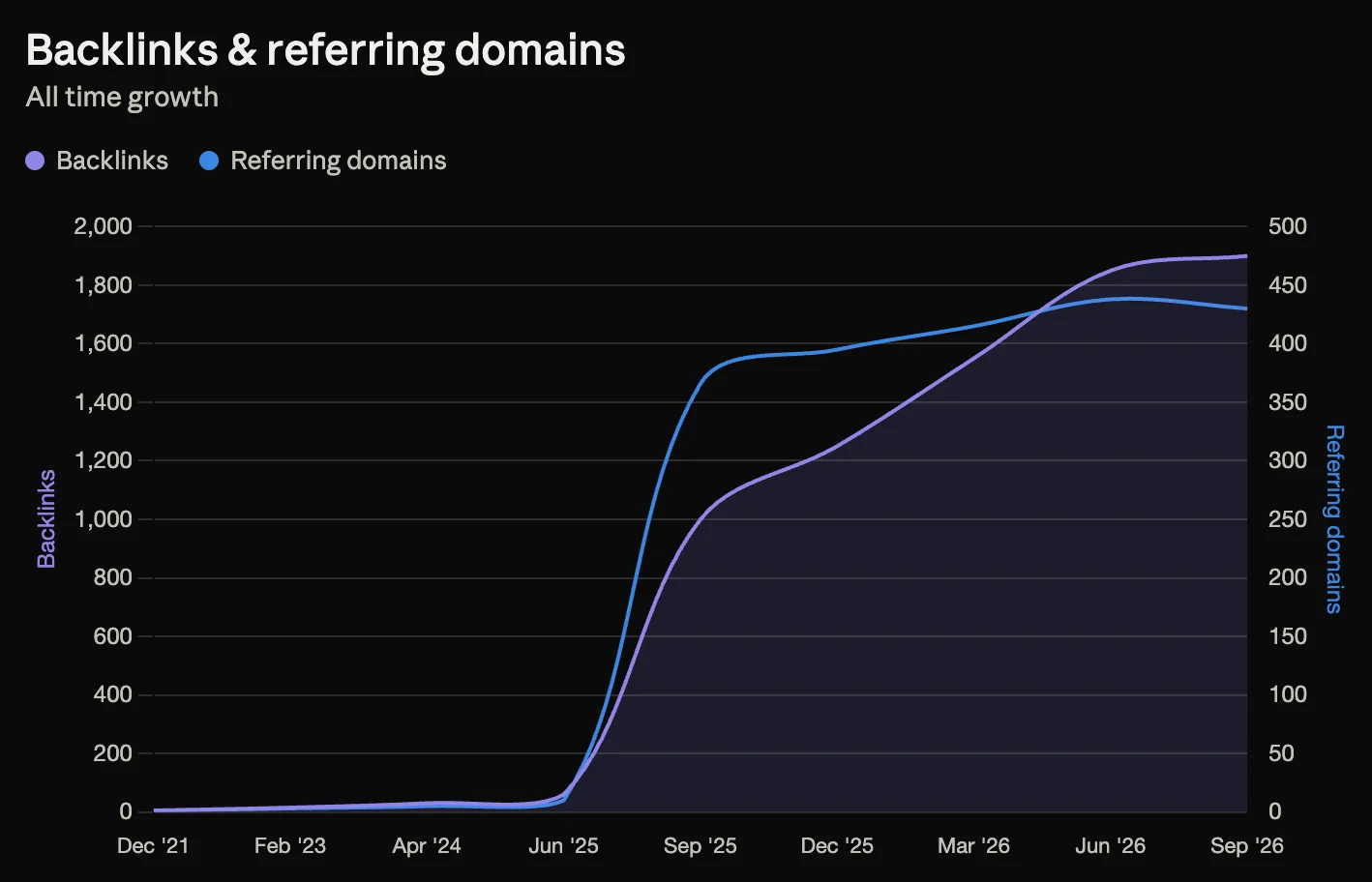
- Referring domains grew from ~366 to ~438 (roughly +20%).
- Total backlinks grew from ~1,000 to ~1,900 (roughly +90%)
Revenue Impact (Paid-Media Equivalent)
Every organic click has a market value; what it would have cost to buy that same traffic through paid search. Using the client’s traffic-weighted average cost-per-click of ~$1.88 across its ranking keyword set:
- Cumulative organic clicks since the engagement began (~4,260) represent an estimated ~$8,000 in equivalent paid traffic value that the client did not have to pay for directly through ads.
- Clicks from the most recent 3 months alone (1,880) represent an estimated ~$3,500 in equivalent paid traffic value for that period.
- Monthly, this represents growth from roughly $1/month in equivalent paid-traffic value at the start of the engagement to approximately $1,180/month today (based on the last 3 months’ click volume at the same weighted-average CPC).
This is a modeled estimate (organic clicks × average CPC for ranking keywords), not client-reported revenue. It’s presented as a directional proxy for the ad-spend value being displaced by organic growth, not a claim about actual sales or revenue.
Client Validation
Midway through the engagement, the client’s own team noticed a positive trend in their Search Console data; they emailed us mentioning their clicks had climbed to roughly 5x year over year. It was a good sign: the growth we were tracking internally matched what the client was seeing independently, straight from their own numbers.
Ready to Get Your Company Found by the Right People?
Veltura Media’s growth wasn’t the result of a single tactic; it followed a deliberate sequence: establish topical authority first, strengthen the commercial core, then layer in conversion-focused and seasonal/AI-search optimization deliverables.
That sequencing is why non-branded searches now account for the overwhelming majority of organic visibility. People are now discovering Veltura by searching for the exact problems it solves, not by already knowing its name.
If you’re ready to see growth for your company like Veltura Media, connect with HeyTony today, and we’ll be in touch!
Explore more work
How a Multi-Location Dental Practice Went From a Fake Traffic Spike to Sustained, Compounding Organic Growth (Client name changed for…
How a Home Maintenance Company Went From 65% Brand-Dependent Traffic to a 95% Non-Branded Organic Engine (Client name changed for…

