How a Home Maintenance Company Went From 65% Brand-Dependent Traffic to a 95% Non-Branded Organic Engine
(Client name changed for privacy.)
When Henry’s Home Maintenance came to us, the business wasn’t invisible online; it was just invisible to strangers.
Almost two out of every three people who found the site organically were already searching for the business by name. Referral traffic, past customers, word of mouth- that engine worked. What wasn’t working was Google introducing the business to anyone who didn’t already know it existed.
That’s a strategy problem, not a traffic problem, and it meant the SEO plan had to focus on earning strangers, not just capturing brand searches that were already coming in.
What We Found
A full audit of the site and its search visibility turned up a company with real service depth and almost no digital footprint to match it:
- Brand-dependent organic traffic: Nearly two-thirds of organic sessions were people searching the business’s own name; a sign the site wasn’t earning new discovery, just harvesting people who already knew where to look.
- Thin keyword footprint: Under 900 total ranking keywords, with almost none in strong positions; the site had a homepage and a handful of service pages, and not much else for Google to index.
- No hyperlocal coverage: The business served a wide, multi-suburb metro area but had no city- or neighborhood-specific pages to capture “near me” and location-based intent outside its home base.
- Missed pre-purchase demand: Zero content answering the concern-driven questions homeowners search before they know which company to call; things like how to spot a failing dryer vent, what mold in a duct system looks like, or how often a home actually needs maintenance.
The business had two real service lines and a genuinely useful offering. It just hadn’t been translated into a site Google could send new customers to.
What We Did
The plan closed the gap between “known by name” and “found by need.” That meant:
- Consistent on-page SEO: internal linking, schema markup, alt text, and heading/title/meta optimization across every page we touched, not just the homepage.
- A steady content engine: Roughly eight new or updated blog and service pages per month, built around the pre-purchase questions homeowners were already typing into Google rather than just product/service descriptions.
- A hyperlocal page buildout: Dozens of city- and suburb-specific service pages rolled out across the metro in a single coordinated push, so the site could compete for local intent well beyond its home city.
- Ongoing off-page authority building, adding several quality backlinks every month from relevant, reputable sources.
- Monthly keyword and competitive research to keep the content calendar responsive instead of running off a plan set once and left alone.
The Results
The clearest way to see what changed since the engagement began is to look at where the numbers moved first: the overall volume of organic traffic, the breadth of keywords now ranking at all, how many of those keywords have climbed onto page one specifically, and, most tellingly whether that traffic is coming from people who already knew the business or from strangers finding it for the first time.
Organic Traffic Up ~14x
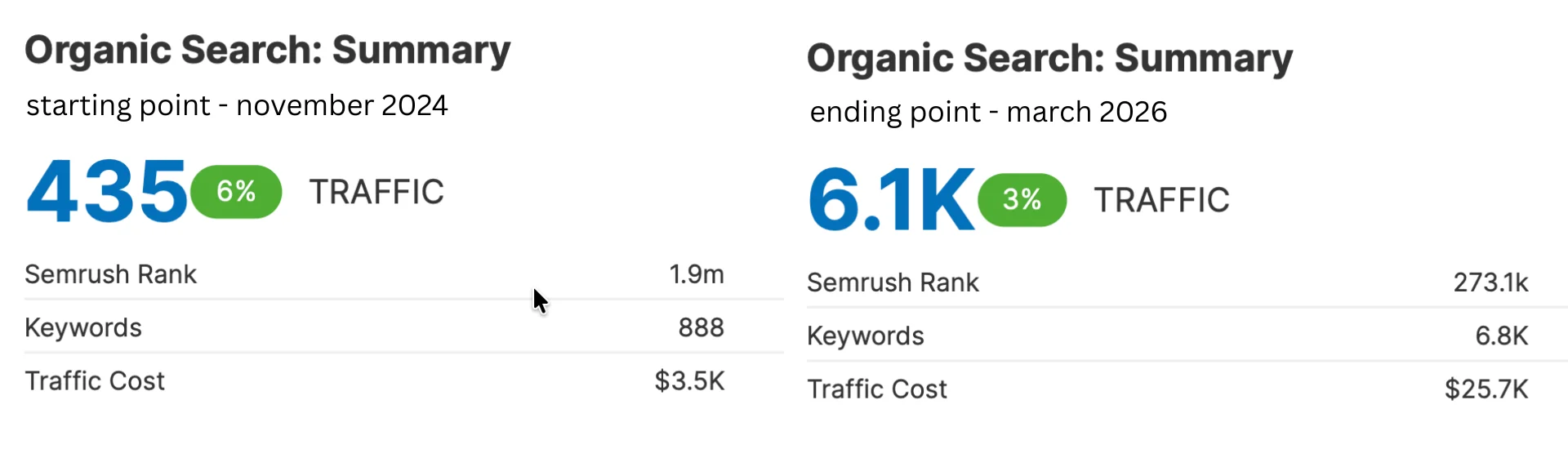
Estimated monthly organic visits climbed from roughly 435 to roughly 6,100, traffic that’s compounded steadily as the content and location pages built out, rather than spiking and fading. This is the topline number everything else below feeds into: more ranking keywords and more page-one placements turned a few hundred monthly visits into a few thousand.
Ranking Keywords Up From 888 to 6,792
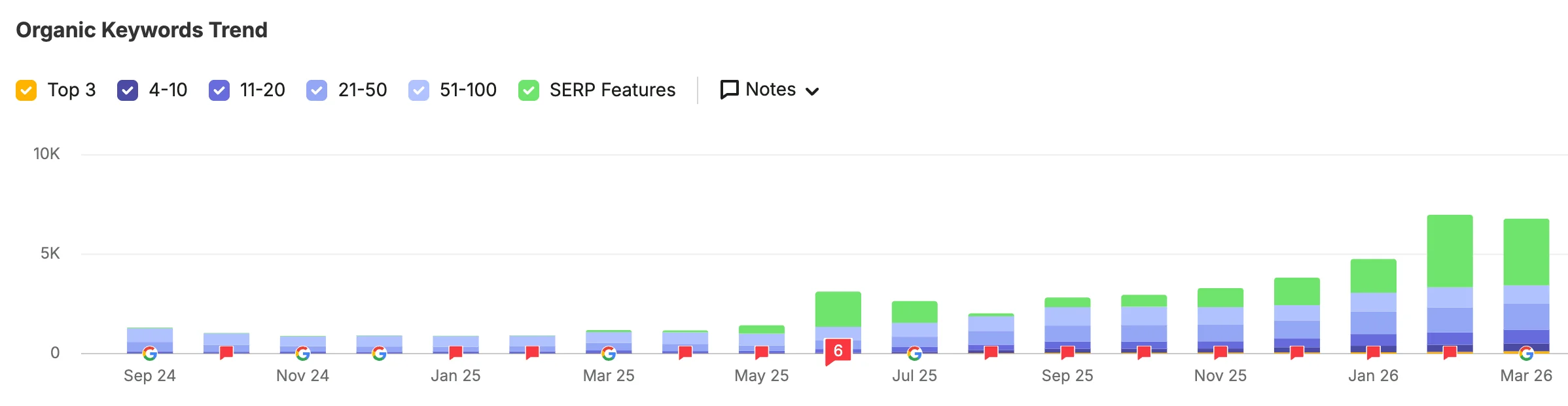 That’s a 7.6x increase in the site’s overall search footprint! The total number of distinct search terms Google now associates with the site in some capacity. Growth like this almost always comes from content breadth, not a handful of pages getting lucky: it reflects steady monthly page and blog output plus the hyperlocal buildout landing across the board, not just on a few flagship pages.
Page-One Keyword Count Up ~19x
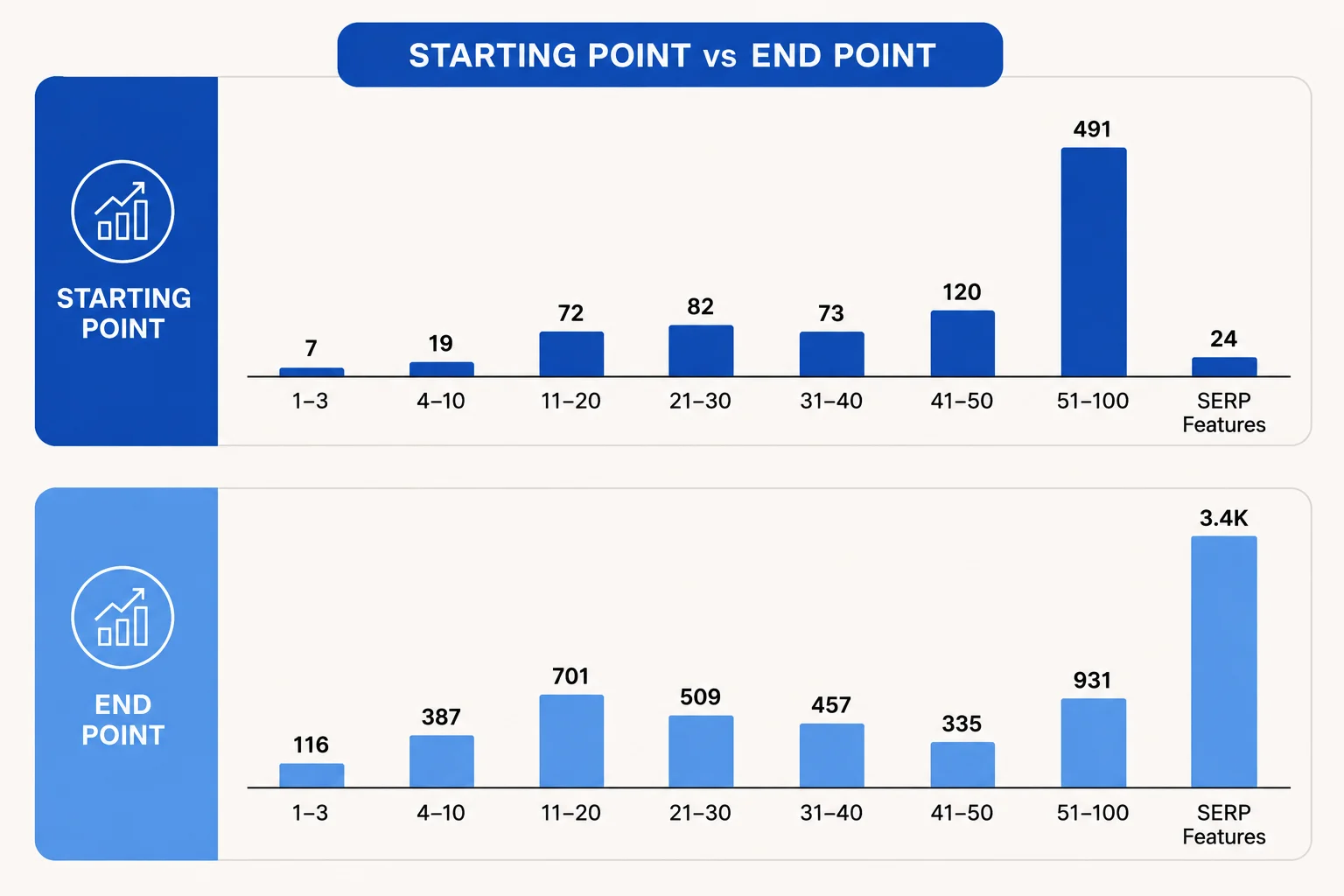
Keywords ranking in positions 1-10 grew from 26 to 503, including a jump from just 7 to 116 in the top 3 specifically. Raw keyword count matters less than where those keywords sit; page one is where clicks actually happen, so this is arguably the single best proxy for “how much of that 6,792 is doing real work” versus sitting buried on page 50.
The Brand-Dependence Problem, Solved
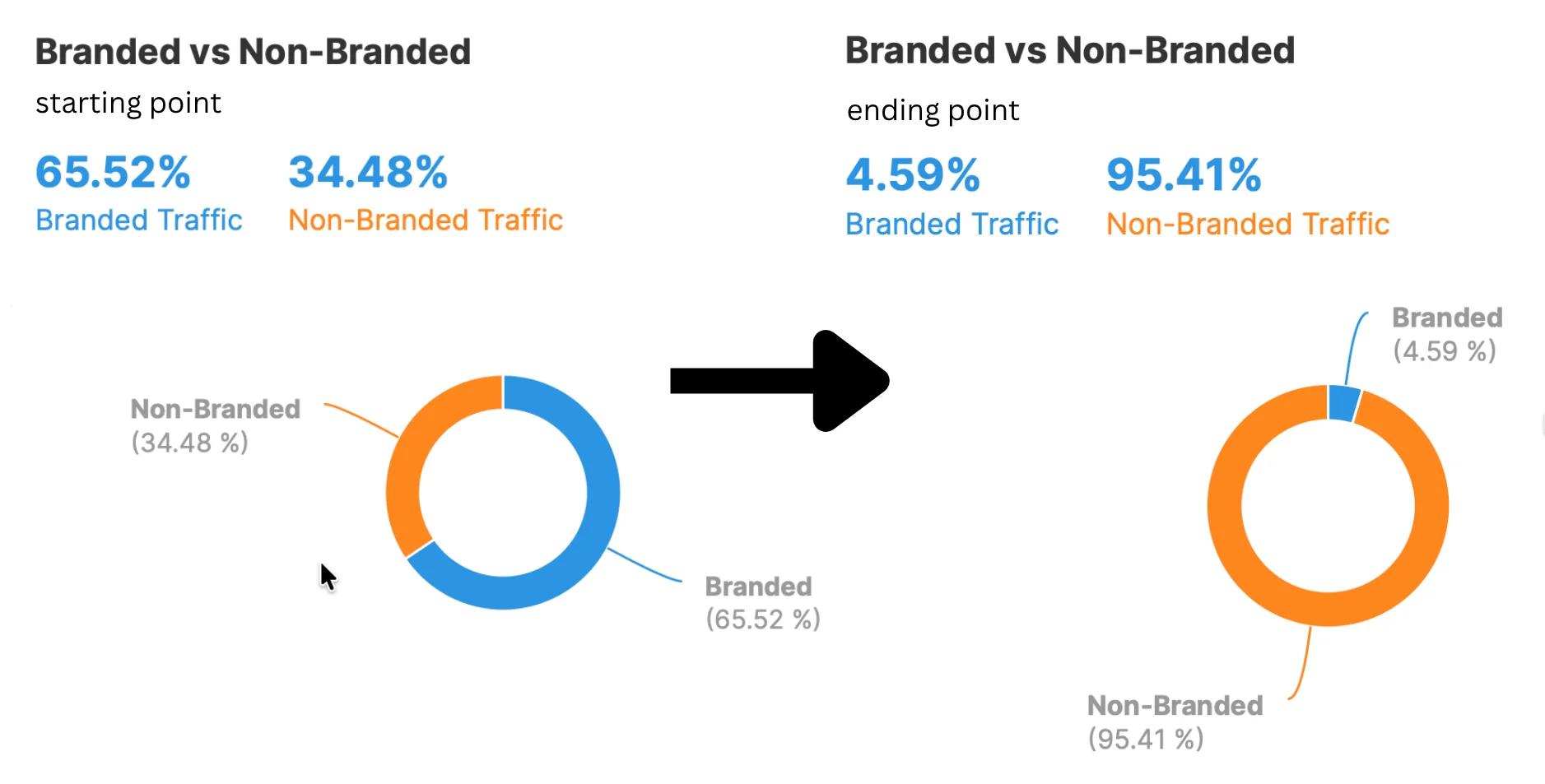
The share of organic traffic coming from people searching the business by name dropped from 65.5% to 4.6%. Today, over 95% of organic visitors are finding the business through generic, need-based searches; people who didn’t know the name until Google gave it to them. This stat answers the original problem directly: the business isn’t just getting more traffic; it’s getting a fundamentally different kind of traffic, which is strangers, not repeat name searches.
Momentum is Still Building
Looking at the earliest month of GSC data still available against the last month in their contract:
- Organic clicks up ~754% (295 → 2,520)
- Impressions up ~139% (275K → 656K)
- Average CTR up 4x (0.1% → 0.4%)
- Average position improved from 48.2 to 6.9; a move from buried on page 5 to sitting on page 1
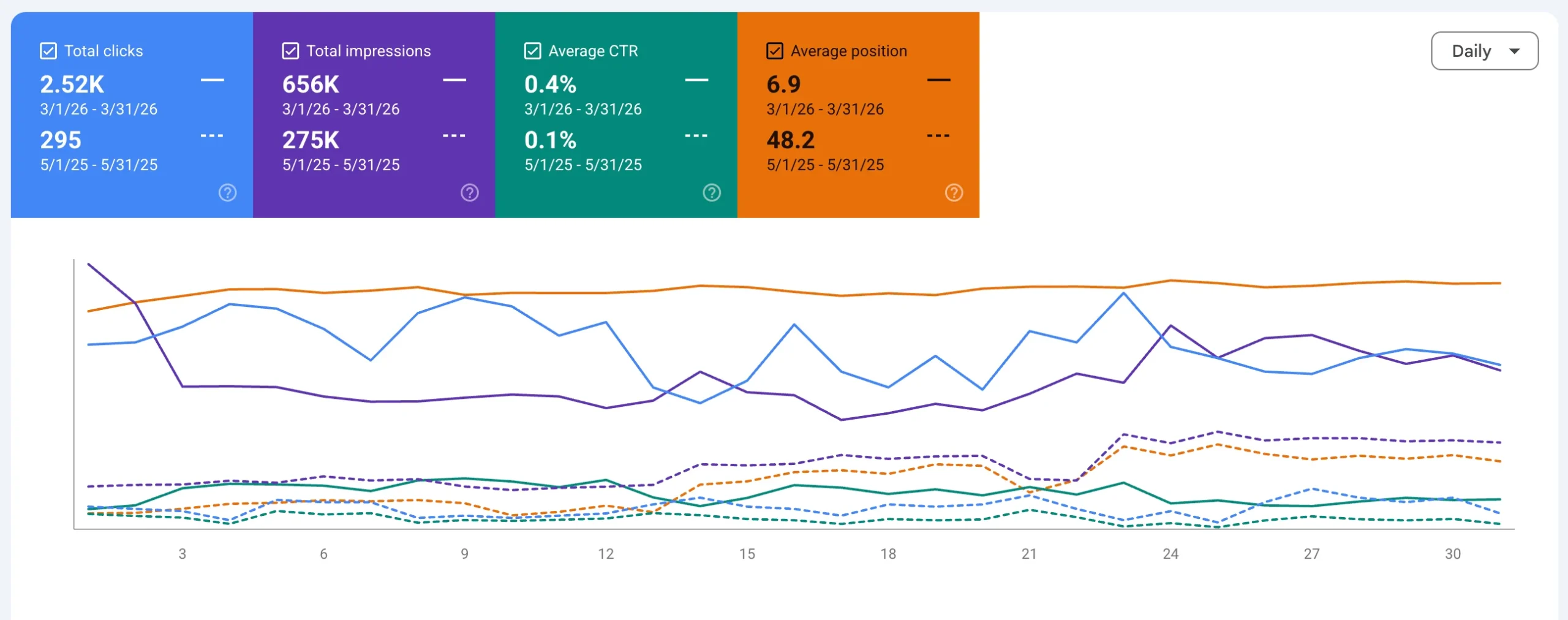
Note: May 2025 is used as the starting point since Google Search Console only retains about 16 months of historical data, not because that’s when the engagement began.
What That Traffic Is Worth
Henry’s Home Maintenance doesn’t yet track organic leads through a CRM, so we’re using the most conservative, always-available proxy: what it would cost to buy this traffic through paid search instead of earning it organically.
- Equivalent paid-media value: ~$3.5K/month → ~$25.7K/month; a modeled estimate based on Semrush’s traffic-cost calculation (organic clicks × average CPC for those terms), not client-reported revenue. That’s roughly $22K/month in additional value the business would otherwise have to spend on ads to replicate.
As lead or booking data becomes available, this is a strong candidate to upgrade to a client-reported or tracked-conversion revenue figure; the traffic is there, the next step is proving what it converts to in dollars.
The Main Takeaway
Henry’s Home Maintenance didn’t need a bigger brand. It needed a site that could stand in for that brand with people who’d never heard of it. Building out the location pages and the pre-purchase content didn’t just add keywords; it flipped the traffic mix from “people who already knew us” to “people who found us for the first time,” which is the only kind of organic growth that actually grows the business.
Note: Client details have been changed for privacy. Performance data is unmodified.
Ready to Get More Traffic?
Results like these aren’t luck or a lucky algorithm update; they happen when on-page work, content, and local SEO all run off the same strategy instead of three different ones. If your business is ready for the same kind of growth, explore our search engine optimization services and fill out the form below; we’ll be in touch asap!
Explore more work
Client details have been changed for privacy. Performance data is unmodified. When Veltura Media came to HeyTony for SEO services,…
How a Multi-Location Dental Practice Went From a Fake Traffic Spike to Sustained, Compounding Organic Growth (Client name changed for…