Wholesale SEO: How Moon Margery Got Found by New Buyers
By Matt Diamante, Founder of HeyTony. #1 Amazon bestselling SEO author, 15+ years in search.
Client details have been changed for privacy. Performance data is unmodified.
A wholesale jeweler of five decades went from about 100 organic clicks a day to a sustained 200+ clicks a day, and 99,500 clicks in the last 16 months alone. Here’s what the wholesale SEO work involved, how long each stage took, and what it changed for this wholesale jewelry business.
Five Decades of Reputation, Zero Search Visibility
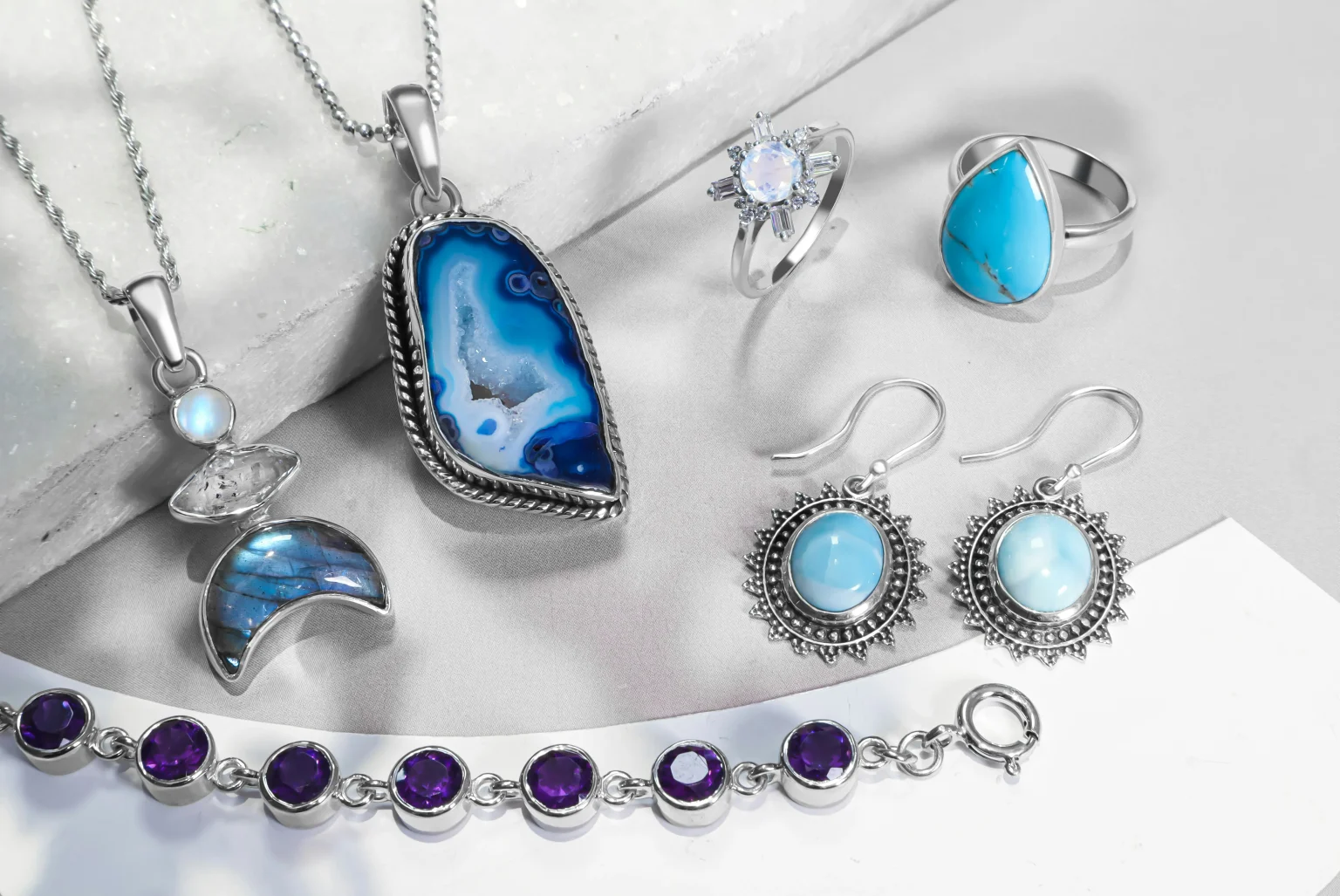
Moon Margery wasn’t panicking. They were plateaued, and they knew it. More than five decades as a wholesale jewelry supplier, sourcing jewelry internationally. Showrooms across the country. A buyer base that reordered without being chased.
Everything a wholesale SEO campaign needs to work with. All of it invisible.
Moon Margery didn’t have a product problem. They had a proof problem.
What the SEO Audit Showed
We audited the site before touching anything. Here’s what was actually on it:
- Hundreds of product pages named after stock codes. A page selling a pendant was titled “MP410.” A buyer searching for wholesale pendants had no way to land on it, because nothing on the page said “pendant.”
- Dozens of collection pages with no copy at all. These are the pages closest to a purchase order. Images, a product grid, and nothing else.
- A handful of blog posts, none answering a buyer’s real questions. Nothing on tarnish. Nothing on cleaning. Nothing on hypoallergenic metal. Nothing on telling the real thing from plated. Every one of those is a question a buyer looks up before placing a first order, and what makes a supplier a trusted source in the industry.
- Five decades of sourcing, with zero content proving it. This was the real gap. The most valuable thing the business owned existed only in the heads of the people who worked there.
This wasn’t a demand problem; Google had almost nothing to rank.
The Wholesale SEO Work We Did
Published on a Schedule
Eight pieces of content per month; two a week, every week. New articles plus full rewrites of pages that already existed and said nothing. The cadence mattered more than any single piece, and the timeline section explains why.
Rewrote the Pages That Take Orders
Collection and product pages got real copy, real title tags, real meta descriptions, and a proper heading structure. Alt text went on every image. Pages that read like a database export started reading like a supplier who knows the category.
Built the Education Layer First
Here is what the client couldn’t see. They assumed the way to rank for their top commercial term was to work on that product category page. It wasn’t.
We built educational content first: what the metal is actually worth, how to care for it, why it tarnishes, how to tell real from plated. Then, we linked it internally to the collection pages. The educational pages earned the links and the trust. Internal linking carried that authority to the pages that take orders.
That layer mattered more than it looks. It is the reason the commercial pages started ranking at all.
Clusters, grouped by where the buyer was standing:
- Ready to order: wholesale product-category queries across every major line in the catalog, plus purity and material qualifiers
- Comparing options: material comparison queries, plus durability and skin-sensitivity questions
- Troubleshooting and aftercare: care, cleaning and tarnish queries, plus authenticity checks
- Planning ahead: trend and seasonal demand queries buyers use when they’re building next season’s order
Fixed the Technical Floor
Schema markup. An internal linking structure built on purpose instead of by accident. Site speed and Core Web Vitals work. Heading tag cleanup. Title tag and meta description rewrites across the catalog.
Built Authority Off-Site
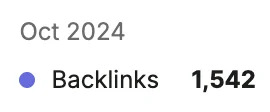
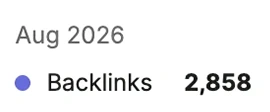
Four placements a month from high-authority sources, alongside the links the educational content earned on its own. Total backlinks grew from 1,542 to 2,858, up 85% (Semrush, October 2024 to August 2026).
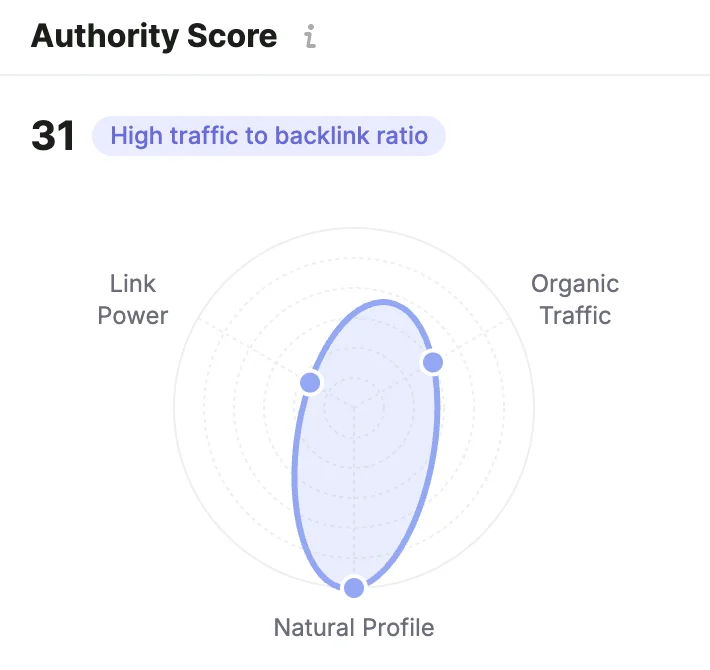
The site’s authority score now sits at 31, with Semrush flagging a high traffic-to-backlink ratio: the content pulls more traffic than the link profile alone would predict.
Monthly competitive research informed the plan on a rolling basis rather than locking us into a static strategy. Generic content would have ranked and converted nothing here; a wholesale buyer can tell in one paragraph whether a supplier actually knows the category. That’s how we approach SEO: win where the competition isn’t looking first, then move up.
We didn’t sell them a magic bullet. We showed them the map and walked it with them, one month at a time.
How Long Wholesale SEO Actually Takes
Nothing broke open in month one. Most agencies quote six to twelve months before results land. That range is roughly right, but it hides the shape of the curve. Here is what the shape actually looked like.
The first few months were slow. More impressions than clicks. Small gains, no headline. It grew every single month, but it grew quietly. Twelve months in, it took off.
That delay is the mechanism, not a fault. An article published in spring spends the summer earning links and slowly climbing. By the following spring it ranks, and every internal link pointing from it to a collection page is finally worth something. The pages published in the first quarter of the engagement were doing their best work a year later.
That’s why cadence beats any single post. Eight pieces a month means eight new assets compounding every month, on top of everything published before them.
What Changed in the First Year
All traffic figures come from Google Search Console and our monthly performance report. Within the first year of tracked data, daily organic clicks roughly doubled, from about 100 a day in spring 2025 to a sustained 200+ clicks a day. That is a new floor, not a good month.
July 2026 against July 2025:
| Metric | July 2026 | Change |
|---|---|---|
| Clicks | 7,200 | up 84.7% |
| Impressions | 1.4 million | up 39.8% |
| AI and LLM Referral Sessions | 121 | up 181.4% |

Those figures cover Google, Bing, and LLM referrals combined. In absolute terms, clicks went from roughly 3,900 in July 2025 to 7,200 in July 2026. Clicks are visits from a search result. Impressions are the number of times a page appears in results. LLM sessions are visits referred from AI assistants.
New buyers, not existing accounts. Of the top 30 keywords by clicks in July 2026, 22 were unbranded.
The best-performing page on the site isn’t a product page. It’s an educational article answering a common valuation question, and it alone accounts for roughly one in every ten organic clicks.
Where They Sit After Nearly Two Years
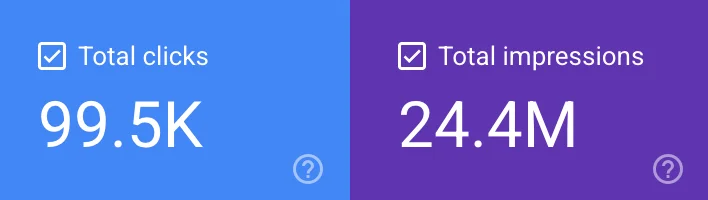
We’ve worked on this site since October 2024. Google Search Console only retains 16 months of data, so the click figures cover spring 2025 onward: 99,500 clicks from 24.4 million impressions.
Market position across the full engagement, October 2024 to August 2026 (Semrush):
| Before | Now | |
|---|---|---|
| Top 3 Rankings | 90 | 468 |
| Positions 4-10 | 265 | 1,897 |
| AI Overview Appearances | 54 | 1,577 |
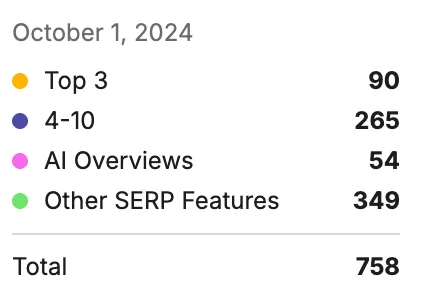
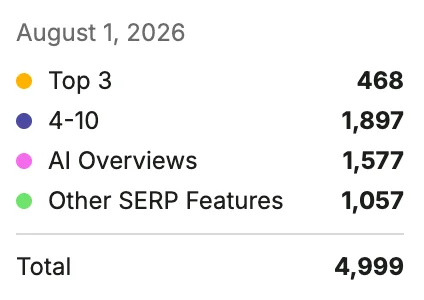
Keywords in the top 10 went from 355 to 2,365.
Those 1,577 AI Overview appearances are visibility, not traffic. The traffic side is counted separately, and it’s growing fastest of anything on this page: 121 sessions referred from AI assistants in July 2026, up 181.4% year over year.
Where the Buyers Come From Now
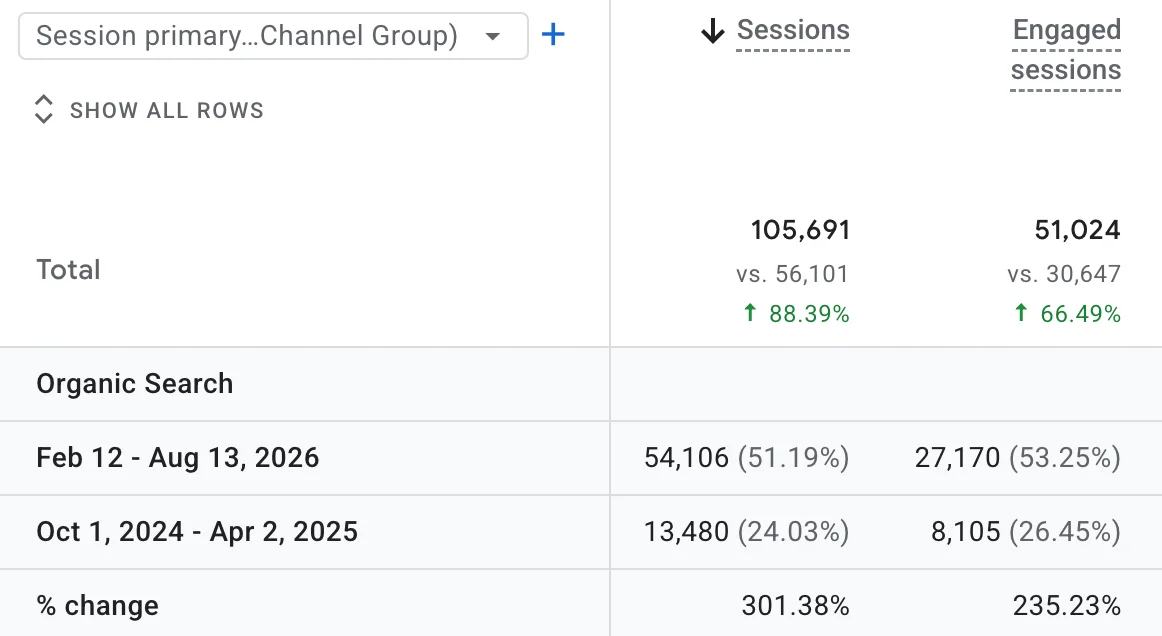
Organic sessions grew from 13,480 to 54,106 across matched six-month windows, up 301%. Organic went from a quarter of all site traffic to more than half. (GA4, Organic Search sessions, October 2024-April 2025 versus February-August 2026.)
At an average cost per click of roughly $0.65 across this keyword profile, the organic traffic the site earns now is worth about $4,000 a month in equivalent paid spend, up from roughly $2,000 a month early in the engagement. That’s around $48,000 a year in traffic the business no longer has to buy. Estimate based on Google Search Console click volume and market CPC, excluding branded search.
The catalog didn’t change. The number of people who could find it did.
FAQs Wholesale Suppliers Ask Us
How long before wholesale SEO produces results?
Plan on six to twelve months before the curve turns. In this engagement, small monthly gains started inside the first quarter, and the breakout came at month twelve. Anyone promising a faster turn on a catalog site with no existing content is guessing.
Does search work for B2B and wholesale, or only retail?
It works, but the buying path is different. Wholesale buyers research suppliers long before they request pricing, and most of that research is informational. Of this client’s top 30 keywords in July 2026, 22 were unbranded; buyers who had never heard the name.
Should a wholesaler fix product pages or write content first?
Product pages first, but they won’t hold without content behind them. Product and collection pages need real copy to rank at all. Educational content is what earns the authority those pages need.
How do you measure it?
First-party data only: Google Search Console for clicks, impressions and position, GA4 for sessions and channel mix. Third-party traffic estimates are modelled, not measured, and they will not match what your own reporting says.
What Any Wholesale Supplier Can Take From This
Moon Margery didn’t have a product problem. They had a proof problem.
This isn’t a story about tactics. It’s a story about a business that spent five decades earning expertise and never once put that expertise anywhere Google could read it. The catalog was never the asset. The knowledge behind the catalog was.
If your business is the one every buyer in your industry already trusts and no new buyer can find, that’s the problem we solve.
Ready to Be Found by New Buyers?
Your buyers are searching. The question is whether anything on your site answers them. Take a look at our search engine optimization services and what a content system built on real expertise can do for a catalog that’s been sitting quiet.
Categories:

