From 7 Blog Posts to 41,028 Organic Clicks in 12 Months
A personal-care studio in a major US metro had almost everything a local business is supposed to need. Close to two decades in business. A four-figure five-star review count across the major review platforms. A highly distinctive brand voice.
What it didn’t have was a website doing any of that work for it.
By mid-2025, the blog had seven posts on the site. Six of them had gone up inside a single week that spring. Then nothing for more than three months. The studio stayed full on word of mouth and social, not because someone in the metro searched for the service and found them.
That’s the gap we set out to close in Q3 2025.
What HeyTony Found In The Preliminary Site Audit
As part of our SEO optimization strategy, we audited the site against the studio’s actual search opportunity. Here’s what was holding it back:
- A blog that had stalled out. Seven total posts and a three-month publishing gap. In a category where nearly every customer searches a question before booking, that’s a lot of demand going to competitors.
- No coverage of the buying journey. Nothing on pain, prep, aftercare, or first-timer nerves, which meant missing the question keywords customers ask at every phase of their decision.
- Almost nothing for a second, high-value audience. The studio had served this segment for its entire history and had a service page for it. The blog had one post.
- Metadata written by accident. Older posts had no custom meta descriptions, so the CMS pulled the first paragraph of each article into the search snippet instead.
- Images working against speed and relevance. Older posts used raw stock-library filenames, uploaded as JPGs with no descriptive alt text.
- Inconsistent social proof. Review counts contradicted each other page to page, undercutting the business’s strongest trust signal.
This wasn’t a brand problem or a reputation problem. It was a coverage problem. Google had almost nothing to rank.
What We Did To Improve Google Ranking
The studio wasn’t lacking expertise or reputation; it was lacking coverage. So we built a strategy around the two things Google had nothing to work with: content that answered what clients actually search, and the technical fundamentals to make it rank.
Built A Content System, Not A Content Dump
We moved the blog to a weekly publishing cadence and held it there for twelve straight months. 51 new posts went live over that year, taking the library from 7 posts to 58. Using SEMrush’s Keyword Magic Tool, we mapped every post to a real search with real intent, organized into four clusters:
- Aftercare and troubleshooting queries: the symptoms, side effects, and “is this normal” questions that follow a first appointment
- Comparison and decision queries: this service vs. that one, this method vs. that method, and the tier-by-tier choices customers weigh before booking
- First-timer objection queries: does it hurt, how long does it take, and the health, timing, and sensitivity concerns that stop people from booking
- Secondary-audience queries: a full cluster for the underserved segment, supported by a city-level service page built for it
That last cluster mattered more than it looks. The segment is high-value and low-competition in most metros, and this studio had two decades of credibility in it and zero content to prove it.
Rewrote The Homepage To Rank In The Search Results
The homepage had no clear keyword target. We rebuilt it around one primary local keyword with two secondary local targets, then wrote a title tag that led with the keyword and paired it with the studio’s strongest offer. The meta description stacked five concrete reasons to click (price, offer, policy, social proof, and a speed promise) so the decision started in the search results, not on the page.
It works. The homepage now converts at a 10.97% click-through rate across 159,000 impressions, and the studio holds page-one positions on the local terms that actually drive bookings:
| Keyword pattern | Avg. position |
| [secondary audience] [service] [city] | 2.18 |
| [core service] [city] — variant A | 2.01 |
| [city] [core service] | 2.78 |
| [city] [category] | 3.12 |
| [category] near me | 3.96 |
| [category] [city] | 4.69 |
| [core service] [city] — variant B | 5.57 |
Fixed The Technical Fundamentals On Every New Page
- Custom, purpose-written meta descriptions with a call to action on every post
- Descriptive, keyword-led image filenames and alt text
- WebP image format on all new uploads for faster loading
- City-specific service pages for the primary offer and for the secondary-audience offer
- Internal links from every blog post back to the relevant service and booking pages
Wrote it In The Brand’s Actual Voice
This part is easy, but expensive, to skip. It was also the hardest to get right. The studio has a highly distinctive brand voice, and generic SEO content would have ranked and converted nothing, as would a straight optimization pass. In an oversaturated local category full of interchangeable copy, that voice was the differentiator, so we matched it post for post. Every article now reads as the studio wrote it, which is what turns a ranking into a booking.
The Results
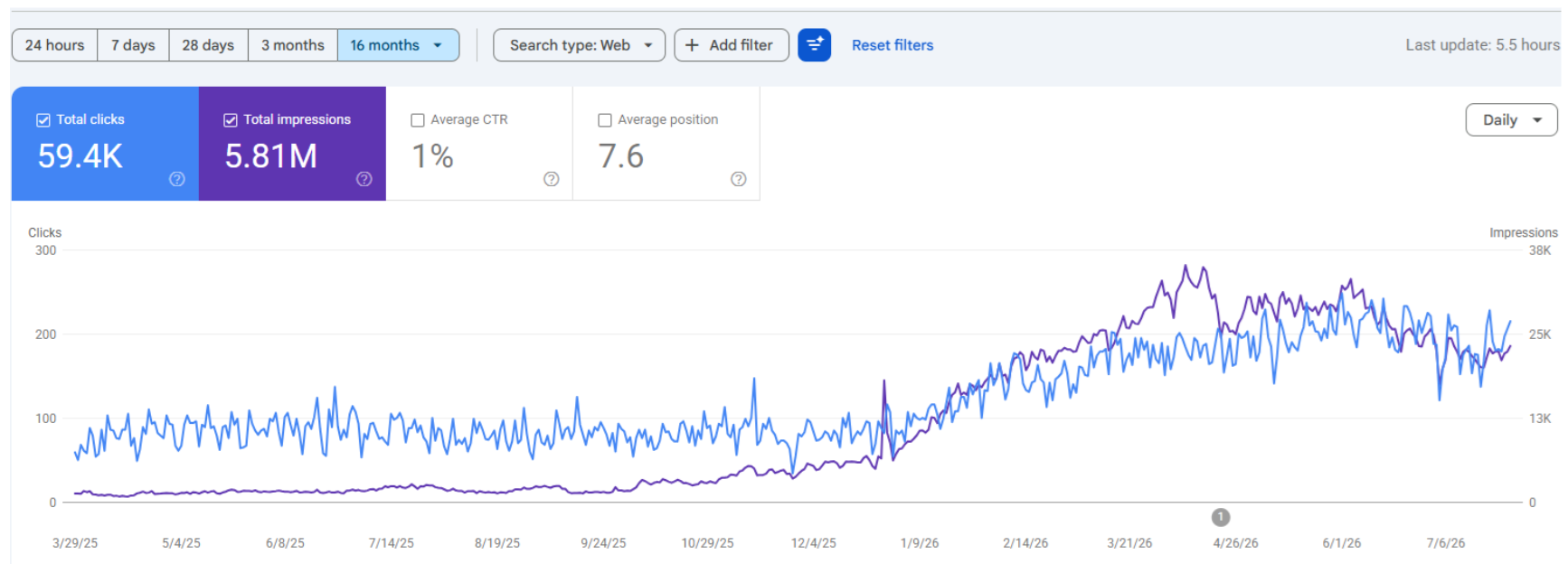
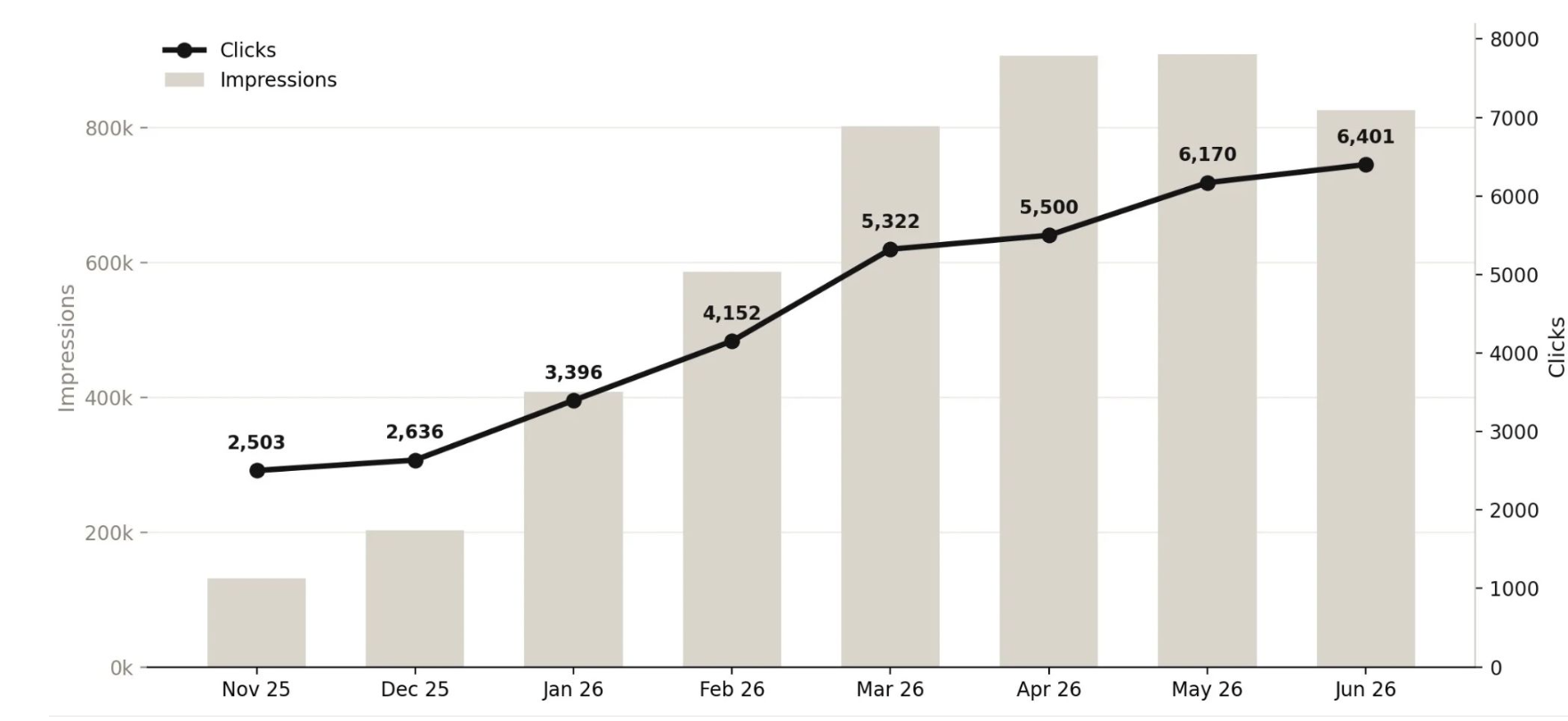
Tracking roughly ten months of Google Search Console data (Q4 2025 through Q3 2026):
- 41,028 organic clicks and 5.34 million impressions
- +122% growth in organic clicks (first 90 days of tracked data vs. the most recent 90 days)
- +269% growth in impressions over the same comparison
- Daily organic clicks went from 90 to 200, sustained
- 171 non-branded keywords ranking in the top 3, with another 680 in positions 4–10
- 87% of clicks from the United States, confirming the traffic is the right audience, not international noise
The Blog Became Half The Business
The blog now accounts for 48.8% of all organic clicks to the site, spread across 65 pages. A year ago, that library was seven posts.
The single best-performing non-branded page is the foundational explainer on the core service, which was the very first post we published. It has earned 3,115 clicks from 810,000 impressions and holds an average position of 6.33 on one of the most competitive informational terms in the category.
Right behind it: the secondary-audience guide (1,497 clicks), a common-concern explainer (1,782 clicks), and a first-timer objection post (1,287 clicks). All ranking for terms the site had zero presence on before the engagement.
The compounding is the real story. Posts published in the autumn spent the winter maturing and were driving traffic by spring, which is exactly why the cadence mattered more than any single post.
What That Traffic Is Worth
Traffic doesn’t pay the bills, so here’s the same result in dollars.
Every organic click has a market price: what the studio would have to pay to buy that same visitor through search ads. At a $4.00 average CPC for this category and market:
| Organic clicks/month | Equivalent ad spend/month | |
| Before (first 90 tracked days) | ~2,700 | ~$10,800 |
| Now (most recent 90 days) | ~6,000 | ~$24,000 |
That’s roughly $13,200 per month in recurring media value the studio no longer has to buy, and across the full tracked window, 41,028 organic clicks represent about $164,000 in equivalent paid traffic.
Estimated, not client-reported. Modeled as organic clicks × average category CPC, using a $4.00 CPC assumption; monthly click volumes derived from tracked daily averages. This is a paid-media equivalence, not booked revenue.
From Invisible To Unmissable
This studio didn’t need a rebrand or a bigger ad budget. It needed a website people could find. We turned two decades of hands-on expertise into content Google could actually rank: 51 new posts on a weekly cadence, mapped to the questions real clients search before they book, and organized into topic clusters that reinforce each other rather than compete. We paired that with the technical fundamentals the site had been missing: purpose-written metadata on every page, keyword-led image filenames, faster WebP assets, city-specific service URLs, and internal links pointing every reader toward a booking. The homepage was rebuilt around a single primary local keyword and now earns a 10.97% click-through rate.
The result: 41,028 organic clicks, a 122% increase in traffic, 171 non-branded keywords in the top three, roughly $164,000 in equivalent paid traffic, and a blog that grew from seven posts into nearly half of all organic traffic to the site.
**Client details have been changed for privacy. Performance data is unmodified.**
If your business is the best-kept secret in your city, we solve that problem. Get in touch with HeyTony for a local SEO strategy built on your expertise.
Categories:
Explore more work
Wholesale SEO: How Moon Margery Got Found by New Buyers By Matt Diamante, Founder of HeyTony. #1 Amazon bestselling SEO…