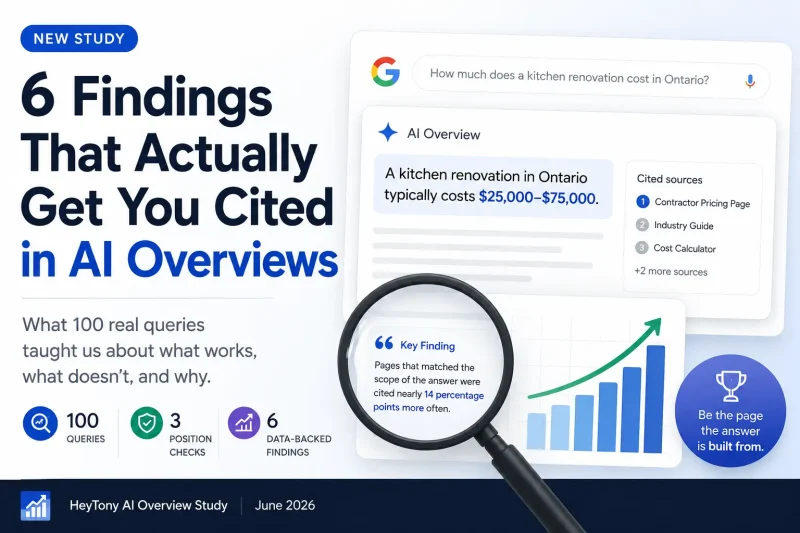
Getting cited in Google AI Overviews comes down to four things: matching the geographic scope of the answer, agreeing with the consensus numbers, picking queries big brands haven’t walled off, and building one page that can supply the entire answer. In our June 2026 test of 100 AI Overviews from Canada, those factors beat formatting, fact density, and publishing first.
The industry data already tells us AI Overviews changed the game. Ahrefs analyzed roughly 4 million AI Overview URLs across 863,000 keywords and found that only about 38% of cited pages also rank in the top 10 for the same query, meaning ranking and getting cited are now two different contests. Their click-through research also shows AI Overviews can cut clicks to top-ranking pages by more than half. And an April 2026 analysis of 1,000 AI Overviews found the top 1% of cited domains capture nearly half of all citations.
So the consensus is clear: citations don’t follow rankings, clicks are shrinking, and citations concentrate hard. What the big studies don’t tell you is what a normal business can actually do about it. That’s the gap I wanted to close. So I built a research agent and ran my own study.
How we tested this
We ran 100 queries across 10 industries: home renovation, legal, insurance, personal finance, healthcare, home services, automotive, education, fitness, and pets. Queries were the kind real customers type: “how much does a kitchen renovation cost,” “why does probate take so long,” “how long does physio take to work.”
Each query was checked 3 separate times over several days from Toronto, because AI Overviews change between visits and we wanted to know which citations were stable and which were noise. Then we collected every cited page, 1,067 in total, plus 163 control pages that ranked on page one but were never cited in any check.
That control group is the part most studies skip, and it’s why so much AEO advice is junk (the SEO industry has a long history of this). If you only study cited pages, you’ll conclude things like “cited pages have schema markup.” One widely shared study reported schema-marked pages get cited 2.3x more often. Maybe. But our control group, the pages that ranked and never got cited, had good structure at almost exactly the same rate as the cited pages. A trait both winners and losers share isn’t a winning trait. You only learn that by comparing.
Here’s what actually separated the cited pages from the skipped ones.
Finding 1: 45% of AI Overview citations are flukes
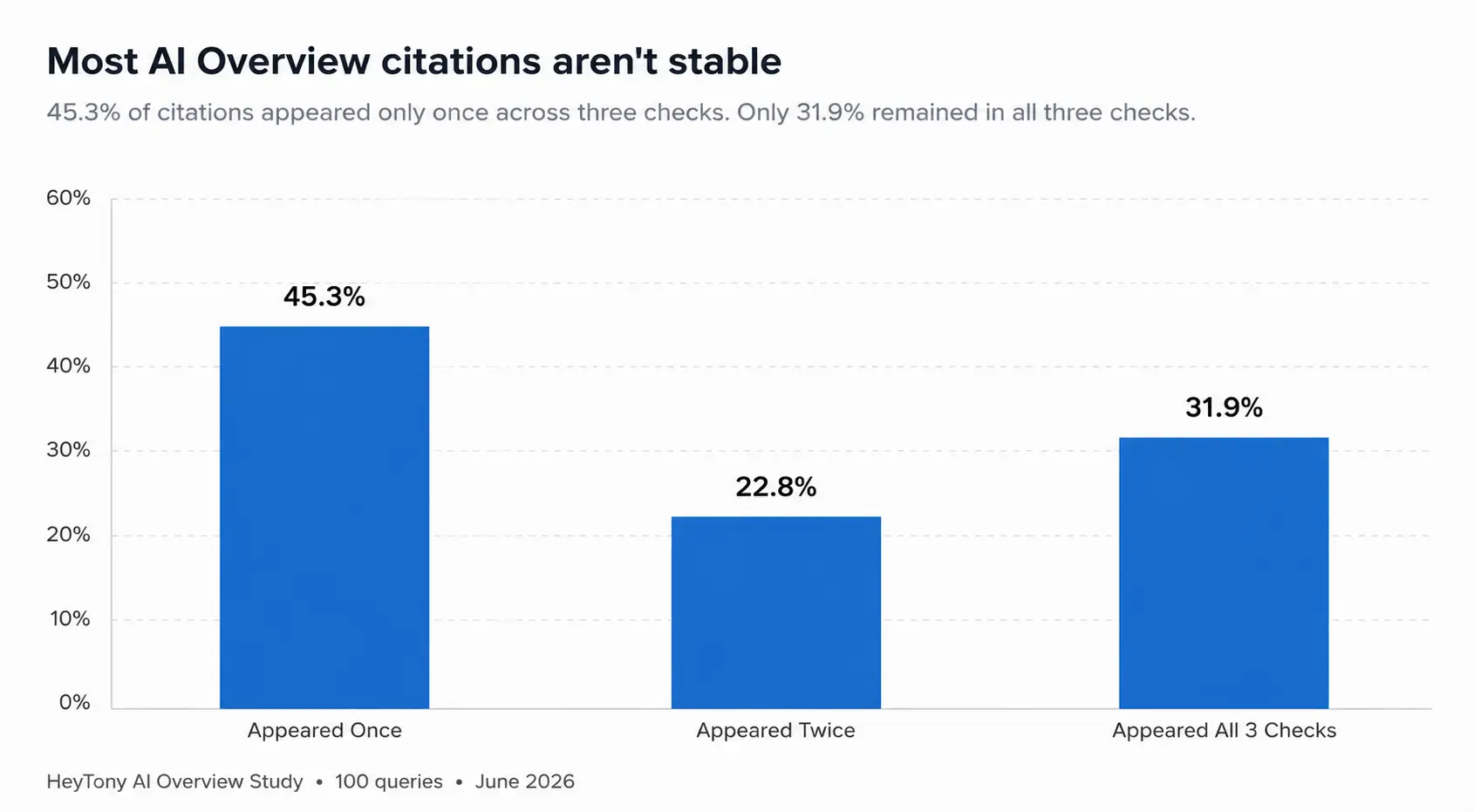
Across our three checks, 45.3% of citations appeared exactly once and never again. Only 31.9% appeared in all three checks.
Practical translation: if you look at an AI Overview once, almost half of what you see in the citation list is temporary. Any AI visibility report built on a single snapshot, whether from a tool, an agency, or your own incognito window, is roughly a coin flip.
Everything below focuses on the citations that lasted, because those are the only ones worth chasing.
Finding 2: Match the scope of the answer, not your service area
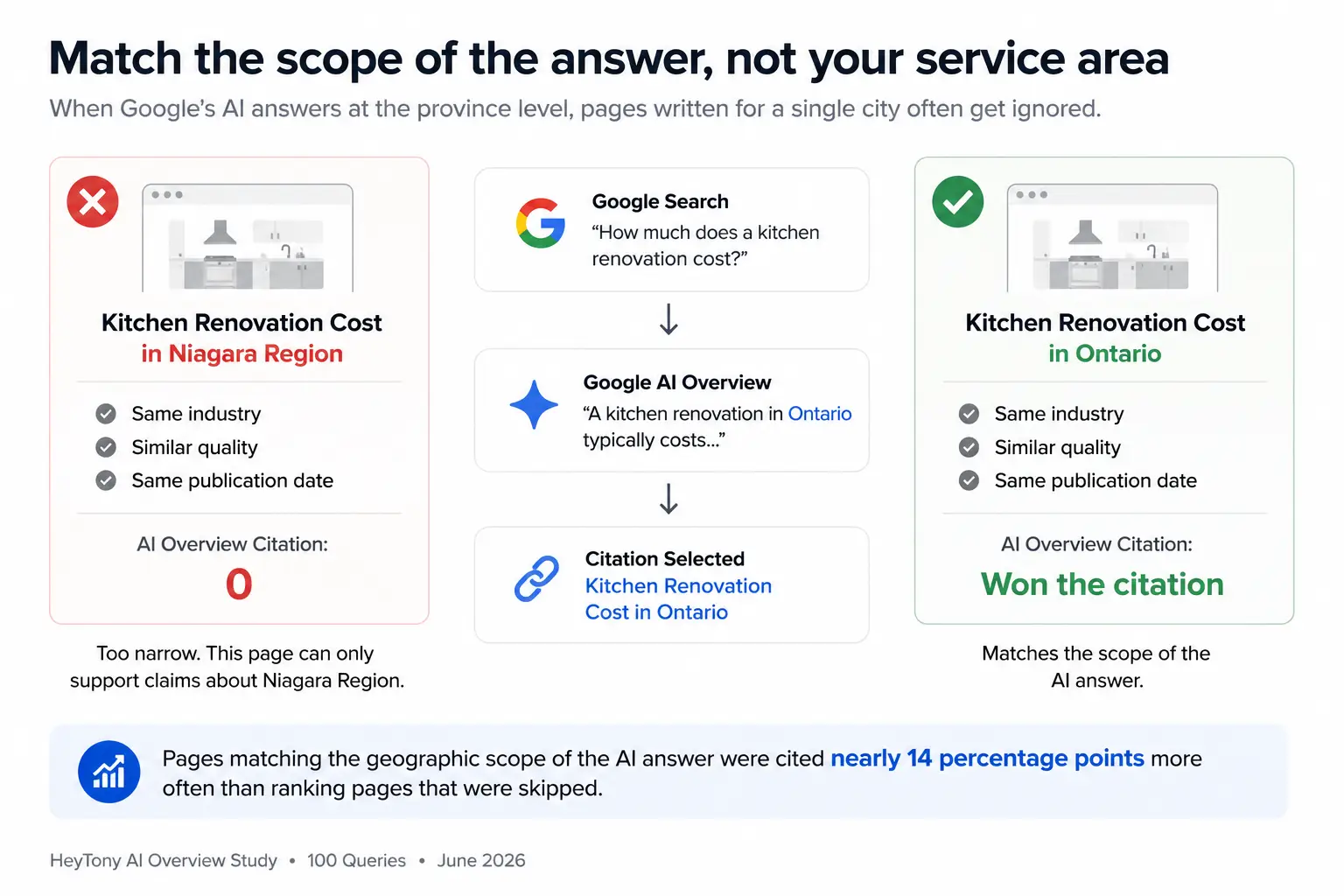
The strongest predictor of stable citation in our data was geographic scope. Pages whose claims matched the geographic level of the AI Overview’s answer were cited at a rate nearly 14 percentage points higher than the ranking pages that got skipped.
Here’s why that matters for local businesses. When someone searches “how much does a kitchen renovation cost” without naming a city, Google’s AI answers at the province level: “A kitchen renovation in Ontario typically costs…” A page that scopes every claim to one city cannot support that sentence. We watched two renovation companies from the same part of Ontario publish similar cost pages in the same month. The one titled “in Ontario” took every citation in the overview. The one scoped to its local region took none. Same region, same business type, similar quality. The label on the claim decided it.
The AI then localizes in the conversation by asking the searcher follow-up questions. Your city page isn’t where localization happens anymore. If you’re building out local pages properly, my local SEO checklist covers the city-level side of the structure.
Finding 3: Agree with the consensus numbers or stay invisible
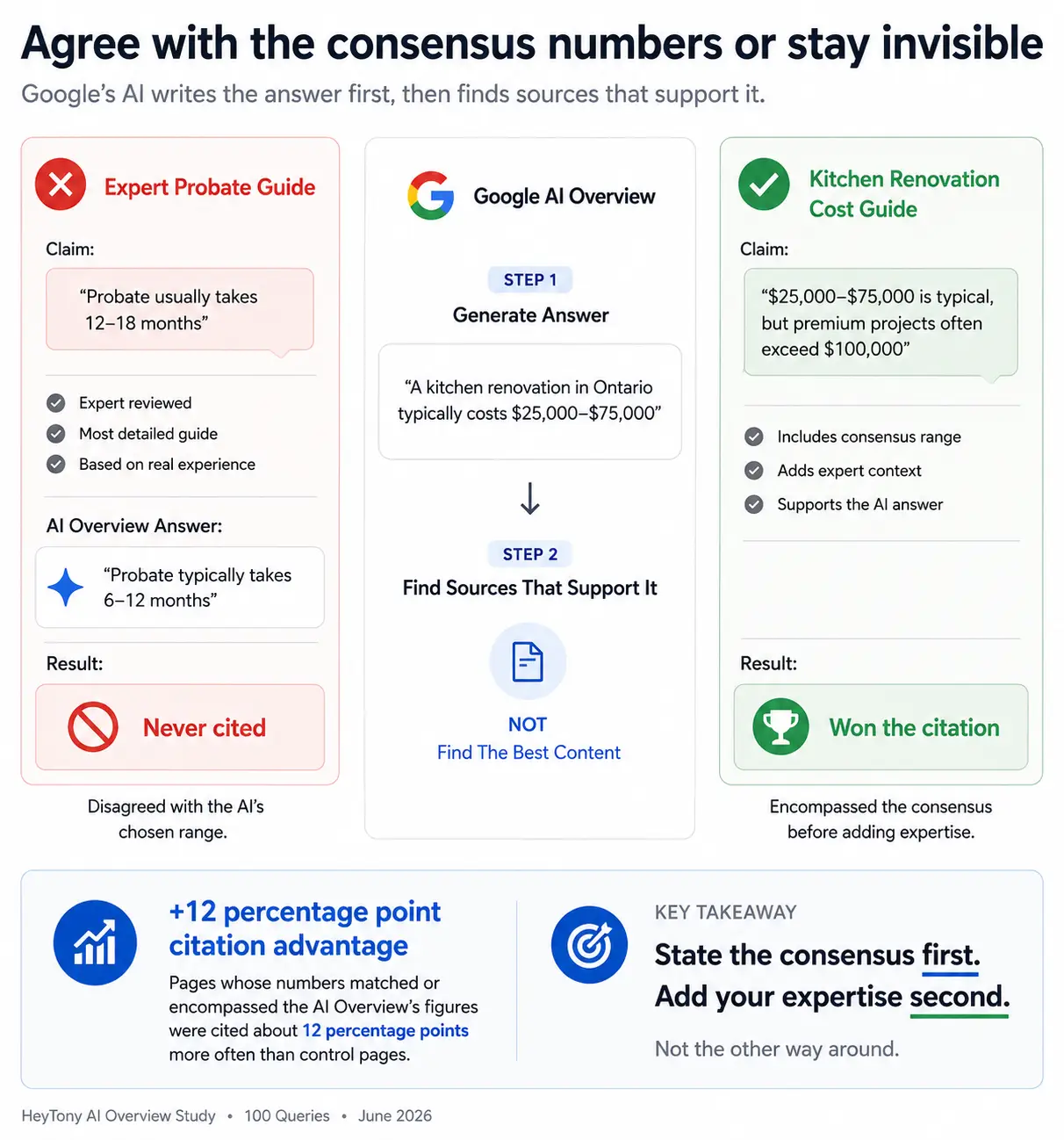
Google’s AI generates its answer first, then selects pages that support the sentences it already wrote. You’re not being judged on quality. You’re being matched on agreement.
In our data, pages whose figures matched or encompassed the AI Overview’s figures were about 12 percentage points more likely to be cited than controls, and that advantage grew the more stable the citation. Among the pages cited in all three checks, number agreement was one of the two strongest signals we measured.
The reverse is brutal. We found a probate guide that was probably the most thorough page on its topic in Canada, expert reviewed, and built around the argument that the commonly cited timelines are misleading. Never cited. We found a renovation cost page with above-market pricing, likely deliberate to qualify leads. Never cited. Disagreeing with the consensus, even when you’re right, makes you unquotable.
The move is to encompass first, refine second. State the consensus range plainly, then add your real numbers as the expert layer underneath it.
Finding 4: Count the big brands before you write a word
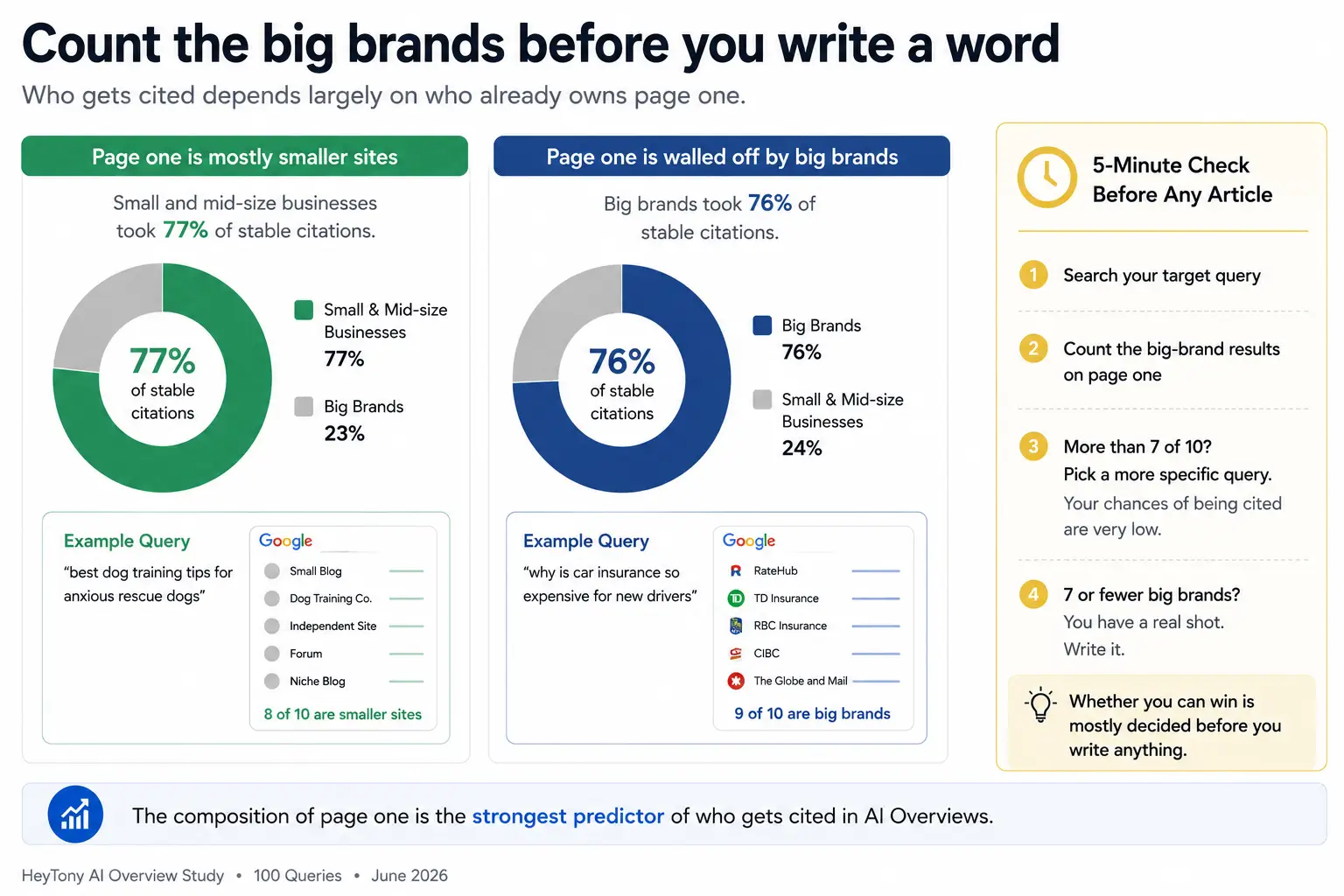
We scored every query by how much of page one belonged to big brands, banks, news sites, and aggregators. In queries where page one was mostly smaller sites, small and mid-size businesses took 77% of the stable citations. In queries walled off by major brands, the big brands took 76%.
Whether you can win is mostly decided before you write anything. “Why is car insurance so expensive for new drivers” belongs to the banks and rate aggregators, and no article will change that. The more specific version of the question usually sits wide open, because big brands write generic.
Five minute check before any article: search the query, count the big-brand results on page one. More than 7 of 10, pick a more specific query.
Finding 5: Most AI Overviews are built from one page
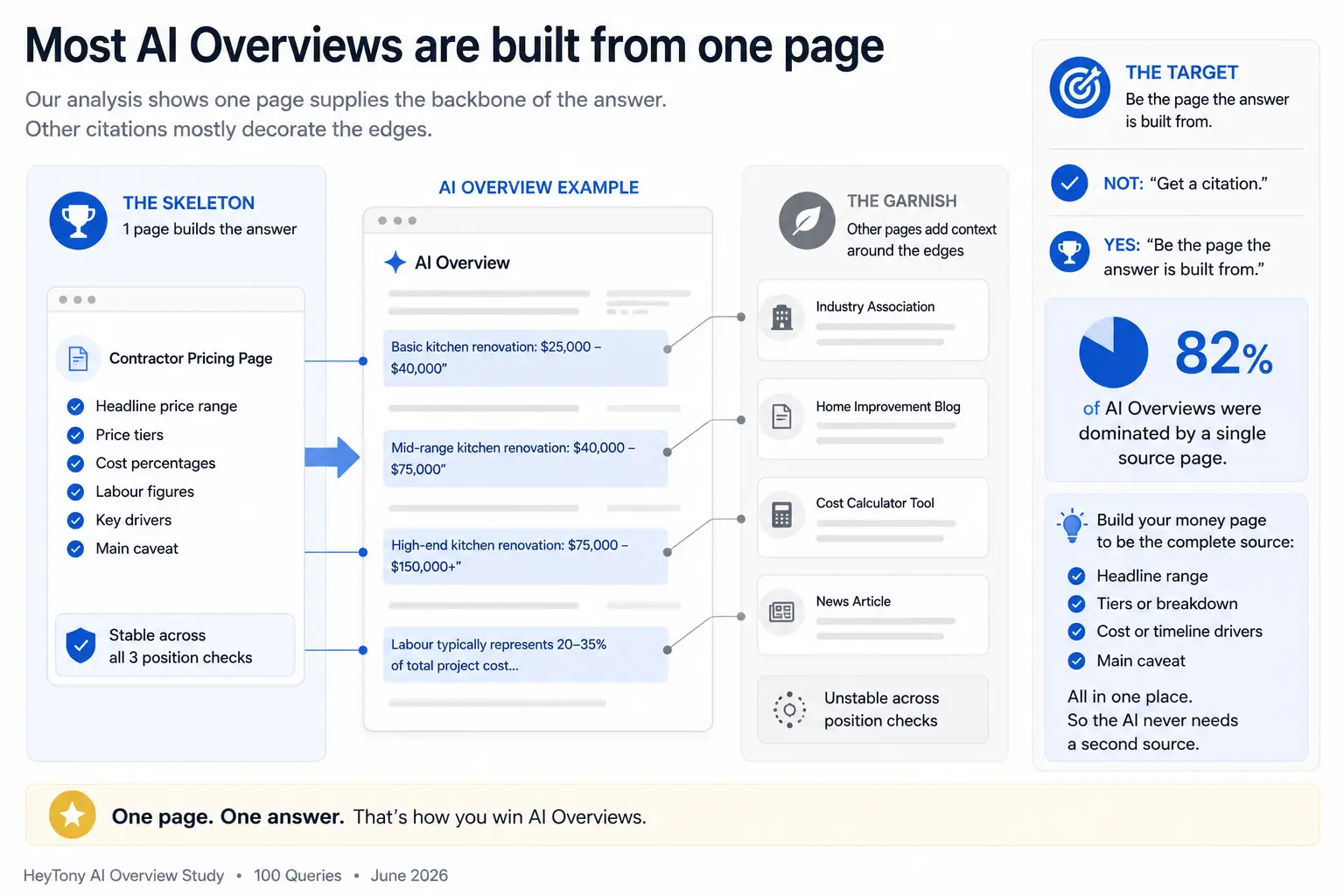
In the large majority of the overviews we analyzed, a single page supplied most of the answer, with other citations as garnish. We watched one contractor’s pricing page get reproduced in an AI Overview almost line by line: their price tiers, their cost percentages, their labour figures, all of it, while other sources decorated the edges.
The garnish citations were also the unstable ones. The skeleton page kept its position check after check.
So the target isn’t “get a citation.” It’s “be the page the answer is built from.” That means your money page needs the headline range, the tiers, the cost or timeline drivers, and the main caveat, all in one place, so the AI never needs a second source.
Finding 6: The stuff that didn’t matter
This part stung, because some of it was my own advice. Three things showed no positive effect once we compared cited pages against the controls:
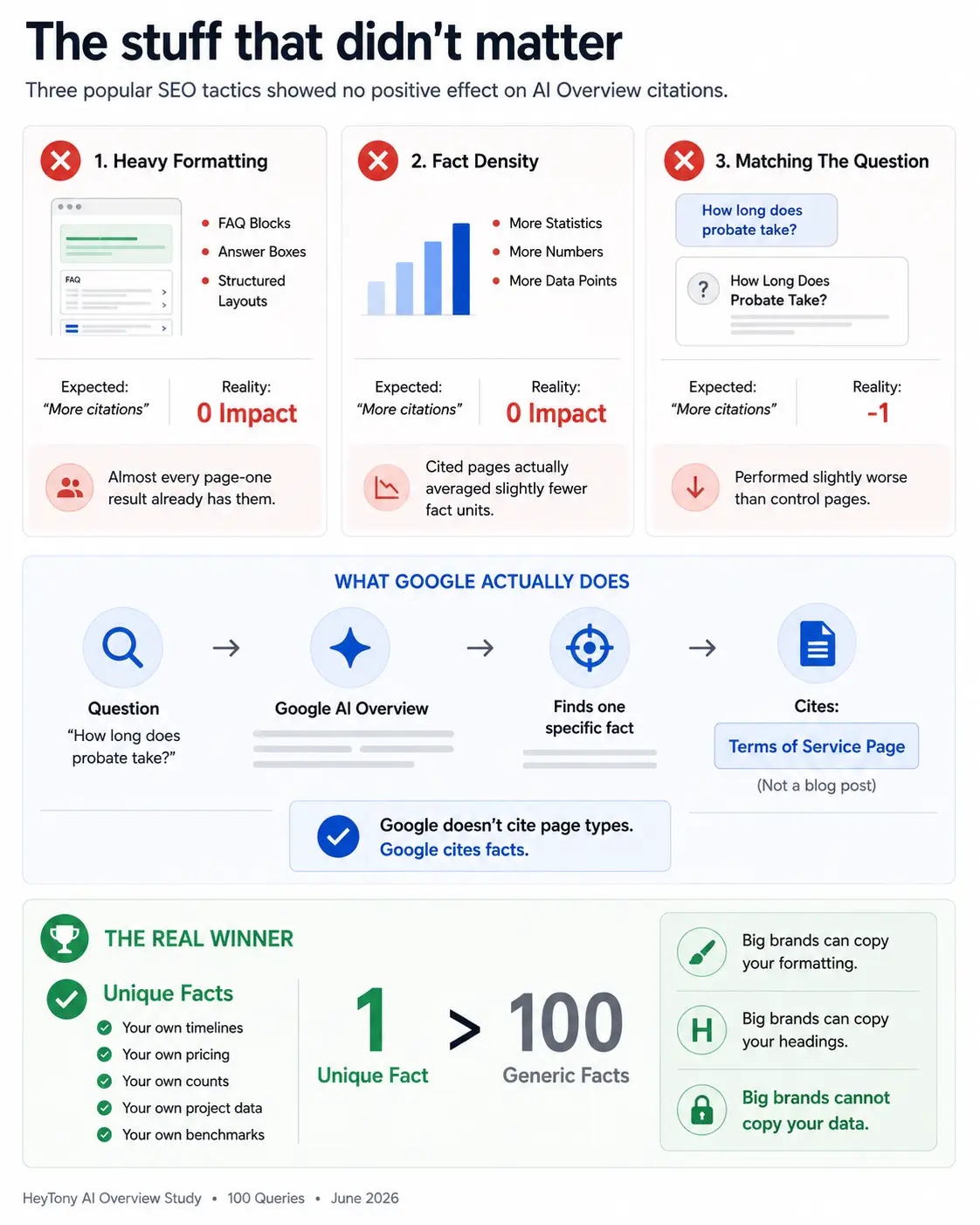
Heavy formatting. Answer boxes, structured layouts, FAQ blocks. Around 85% of every page-one result already has them, cited or not. Structure gets you ranked. It doesn’t get you picked.
Fact density. We counted structured fact units on every page. Cited pages averaged slightly fewer than the skipped pages. Stuffing more stats into a page does nothing.
Matching the question format. Pages with question-style titles and headings matching the query type actually did slightly worse than controls. Google cites specific facts wherever they live. We found a Terms of Service page stably cited for a legal question because it happened to hold a fact the answer needed.
That last one points to the most usable tip in the whole study: put one specific, true, concrete fact that nobody else has into everything you publish. Your own job data, your own timelines, your own counts. Big brands can’t copy your data, and a single distinctive fact can get you cited in overviews you’d otherwise never crack. I’ve seen this firsthand: a single $80 press release got my book into an AI Overview, and it kept influencing that overview even after the publication took the release down.
What to do this week
- Open your most important money page. Does the first paragraph state the consensus number for your industry, scoped to your province? Fix that first.
- If your real pricing differs from consensus, keep it on the page, but underneath the consensus statement, framed as your experience.
- Search your top target query and count the big brands on page one. If it’s walled, list five more specific versions of the question and target those instead.
- Make your money page answer-complete: range, tiers, drivers, caveat, on one page.
- Add one fact from your own business that nobody else on the internet has.
- Check any AI citation three times across different days before you celebrate or panic.
Want a head start? Run your site through my free AI readiness checker first.
FAQ
Do you have to rank on page one to get cited in an AI Overview? No. Ahrefs’ data shows only about 38% of cited URLs come from the top 10, and roughly a third come from outside the top 100. Ranking helps, but citation is a separate selection process based on how well your claims match the generated answer.
Does publishing first matter? No. This whole study started because a page that copied my article’s title, published five days after mine, got cited while mine didn’t. AI Overviews select whatever best supports the answer at retrieval time. There is no originality credit.
Does schema markup get you cited? Not in our data. Structure and markup are near-universal among page-one results, so they don’t separate cited pages from skipped ones. Treat them as table stakes for ranking, not as an AEO tactic.
How often do AI Overview citations change? Constantly. 45% of the citations we observed appeared in only one of three checks. Verify across at least three checks on different days before treating any citation as won or lost.
Does it matter where on the page your answer sits? Probably, yes. A CXL analysis of 100 AI Overview citations found that 55% of cited snippets came from the top 30% of the source page. We didn’t test snippet position in our study, but it lines up with keeping your headline answer near the top rather than burying it.
Is this the same for ChatGPT and other AI search? This study measured Google AI Overviews specifically. The selection logic of generating an answer and then matching supporting sources is common across AI search, but the numbers here are Google’s.
This was 100 queries, tested from Canada in June 2026. I’ll be re-running it quarterly and publishing what changes. If the findings move, you’ll read it here first.
Originally published . Last updated .
Categories:

Explore More