TLDR: Local backlinks for Canadian business growth are one of the most direct levers for improving Google visibility. This guide covers where to find them, how to earn them, and how to manage them over time — without shortcuts or guesswork.
Why Local Backlinks Matter for Canadian Businesses
A local backlink is a link from another website to yours — one with geographic or community relevance. For local backlinks and Canadian business visibility, that distinction is central to how Google ranks local results. A link from the Hamilton Chamber of Commerce carries more weight than a generic offshore directory because it signals geographic relevance — it tells Google your business belongs in that local conversation.
Google doesn’t treat all backlinks equally. A link from a community blog in your city tells a fundamentally different story than a national campaign chasing high-authority links with no location signals.
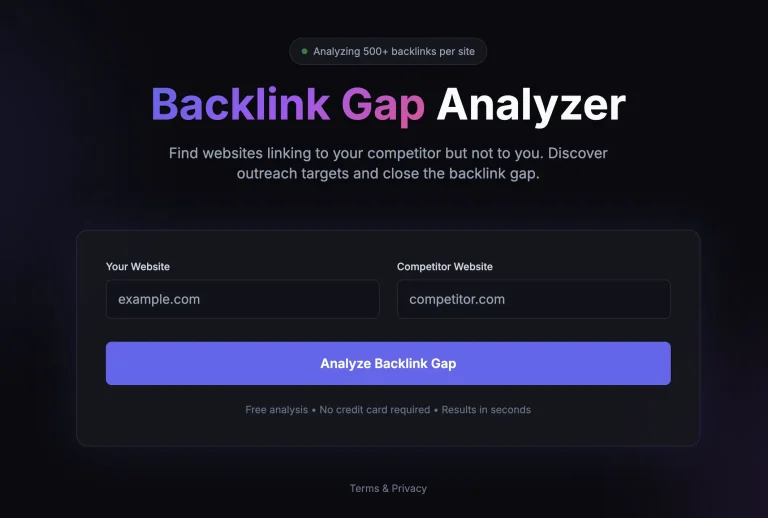
If you want to start mapping your opportunities, you can find local backlinks for free using tools like LinkGap before committing to a full audit.
As Amanda Jordan, local SEO strategist, has noted: “Backlinks function differently in local SEO compared to national SEO, and understanding what local pack rankers have in common is essential for Canadian businesses.”
According to BuzzStream’s 2025 link building research, local relevance has become a stronger ranking signal over time. MIT Blueprint Labs research shows average local employment concentration fell by 5% between 1992 and 2017, reflecting how competitive local markets have become. As more businesses compete for a shrinking share of local economic activity, standing out in local search has become a more crowded fight — and local backlinks are one of the clearest ways to establish that visibility. Differentiated local visibility — built through local backlinks and authority building in Canada — is more important than ever.
How to Find Local Backlink Opportunities Across Canada
Canadian businesses have access to strong local link sources that many owners haven’t mapped yet. Start here:
Canadian directories and associations:
- Yellow Pages Canada, Canada411, BBB Canada
- Local Chambers of Commerce member directories
- Municipal and provincial business associations
- Canadian industry associations relevant to your trade
- University and college partnership pages — especially relevant for Ontario, BC, and Alberta
- BIA (Business Improvement Area) websites
- Local news outlets and community blogs
- Local event sponsorship pages
To find hidden opportunities, try `site:.ca “resources” + [your industry]` or `site:.ca “recommended vendors” + [your city]`. These surface Canadian pages already linking to businesses in your category. For a deeper look at how search operators connect to your overall keyword strategy, see this keyword research guide.
As Anne Smarty, Local SEO Specialist at Whitespark, explains: “Evaluating the current state of local backlinks and citations is critical to developing strategies for acquiring quality local backlinks that improve search rankings.” Before you build, audit what you already have — and what your competitors have that you don’t.
How to Reverse-Engineer Competitor Backlinks for Canadian Markets
This process takes about 30 minutes and gives you a shortlist of proven link sources.
- Enter a competitor’s domain into Ahrefs or Semrush (both offer free trials).
- Navigate to their backlink report.
- Filter by Canadian TLDs (.ca) or by geography where available.
- Sort by Domain Rating (DR) to prioritize high-quality sources.
- Flag any sites linking to multiple competitors — these are “link magnets” already receptive to businesses in your category.
Most SMBs skip this step entirely. Working through a competitor’s backlink profile is one of the most direct ways to find link sources already proven to work in your market.
Building Local Backlinks: Outreach, Content, and Partnerships
Building local backlinks for Canadian businesses comes down to three connected tactics: outreach, content, and partnerships.
Outreach and relationship building. Warm relationship-based pitching outperforms cold email. Start local — reach out to press contacts, podcast hosts, newsletter writers, and bloggers. Personalize every message. A two-sentence email referencing something specific about their publication will always outperform a templated blast.
Content as a link magnet. Create genuinely useful, Canada-specific content people want to reference: a guide to local permit requirements in your province, a regional salary guide for your trade, or a provincial comparison of industry regulations. This earns passive backlinks over time. One of our own evergreen posts has driven over 82,000 visitors — that’s the compounding effect of content that answers a real question. According to BuzzStream’s 2025 research, content-driven acquisition remains one of the most durable strategies available.
Local partnerships and sponsorships. Sponsoring a minor hockey team, charity run, or BIA event almost always earns a backlink from a community page — an under-documented SEO tactic most businesses overlook. Consistent local link building has been shown to meaningfully increase local search traffic over time, with content relevance and source quality driving the bulk of that impact.
| Tactic | Effort | Link Quality | Benefit |
| Canadian directory submissions | Low | Low–Medium | Foundation building |
| Cold outreach to local blogs | Medium | Medium | Steady growth |
| Local event sponsorships | Medium | Medium–High | Community authority |
| Canada-specific evergreen content | High | High | Long-term passive links |
| Warm press/media pitching | High | High | Authority and visibility |
Local Outreach Email Template
Subject line options:
- “Quick note from a [City] business owner”
- “Thought this might be useful for your [City] readers”
Email body:
Hi [Name],
I’ve been following [Publication/Blog Name] for a while — your recent piece on [specific topic] was genuinely useful for local business owners here in [City].
I run [Business Name], a [type of business] based in [neighbourhood/city]. I recently published a guide on [topic] that might fit your audience — it’s specific to [province/city] and covers [brief description].
Happy to send it over if you think it’s relevant.
[Your name]
Personalize the publication name, the article you’re referencing, and what you’re pitching. Generic emails get ignored.
BIA memberships, charity sponsorships, local sports team sponsorships, college and university partnerships, and “Best of [City]” award nominations regularly include a link back to the sponsor’s website. These placements are low-competition because most businesses don’t recognize them as SEO opportunities. The effort is often just showing up and making the ask.
Anchor Text Strategy and Backlink Velocity: What Canadian Businesses Get Wrong
Most local businesses focus on getting backlinks without considering anchor text or acquisition pace. Both affect whether those links help or hurt.
Anchor text diversity. Anchor text signals to Google what your linked page is about. A natural backlink profile supporting local backlinks for Canadian business visibility includes:
| Anchor Type | Example | Recommended Share |
| Branded | “HeyTony” or “Smith Plumbing” | 40–50% |
| Location-modified | “plumber in Mississauga” | 20–30% |
| Keyword-rich | “local SEO services Canada” | 10–15% |
| Naked URL | “heytony.ca” | 10–20% |
| Generic | “click here”, “learn more” | 5–10% |
Over-indexing on keyword-rich anchors triggers over-optimization signals. Branded and location-modified anchors form the backbone of a natural Canadian profile. Understanding how to improve domain authority helps you prioritize which link sources to pursue first.
Backlink velocity. This is how fast you acquire new links. Gaining 50 backlinks in a week after months of inactivity raises red flags for Google’s spam detection. According to BuzzStream’s 2025 research, unnatural acquisition patterns remain a leading cause of manual penalties. Most advice on backlink velocity stays vague. For most Canadian SMBs, 2–5 high-quality local backlinks per month is a safe, sustainable pace that avoids triggering Google’s spam detection.
| Phase | Timeline | Primary Activities |
| Foundation | Months 1–3 | Directories, citations, Chamber listings |
| Growth | Months 4–6 | Outreach, partnerships, sponsorships |
| Compounding | Months 7–12 | Content-driven passive acquisition |
Most HeyTony clients see ranking movement between months 3–6, with significant results around months 7–8. Slow, consistent acquisition builds trust with Google rather than triggering review.
Industry-Specific Backlink Strategies for Canadian Businesses
Backlink strategy looks different depending on your vertical. Here are four Canadian examples with specific source suggestions.
Home Services (plumbers, electricians, HVAC)
Target HomeStars Canada, municipal contractor registration databases, local hardware store blogs, and regional trade association pages. Neighbourhood resource pages are worth a direct ask.
Healthcare and Dental
Target provincial health association directories, local wellness blogs, hospital partner pages, and patient community forums. Multi-location practices need location-specific backlink strategies — each location page should earn links from its own community sources. Willow Dental, a Mississauga dental practice, achieved first-place rankings for 45+ keywords through exactly this kind of location-specific local SEO approach — a direct example of how targeted local backlinks for Canadian businesses translate into measurable ranking outcomes.
Professional Services (accountants, lawyers)
Target CPA Canada resource pages, provincial law society directories, local business journals, and regional award lists — high-DR sources with genuine local authority.
Retail and E-commerce
Target local lifestyle bloggers, regional gift guides, BIA shopping pages, and local media features. Many cities publish annual “shop local” roundups — getting included is often just a matter of submitting your business.
For any vertical: two or three strong, relevant local links outperform twenty links from irrelevant directories.
Buying Backlinks vs. Building Them: What Canadian Businesses Need to Know
The question of whether to buy backlinks deserves a straight answer.
There’s a spectrum. White-hat link building — earned through content, outreach, and partnerships — is fully Google-safe. Grey-hat paid placements on editorial sites are common and risky. Black-hat schemes like private blog networks and mass directory spam carry the highest penalty risk and lowest long-term value.
The market for purchased backlinks exists. Some services do sell links to local businesses in Canada. The risk is real: Google’s Spam policies cover unnatural link schemes, and a manual penalty can set a domain back significantly. Recovery is possible but slow.
Consistent local link building has been shown to meaningfully increase local search traffic — but that outcome depends on link quality and relevance, not volume. Purchased links rarely meet that bar. If you’re unsure where to start, our SEO services are designed for Canadian small businesses building a long-term local presence.
According to BuzzStream’s 2025 research, recovering from link penalties takes time. Prevention is always the better path.
How to Monitor and Maintain Your Backlink Profile Over Time
Building backlinks isn’t a one-time task. Links disappear — sites go offline, pages get removed, and resource pages get updated. Tracking this monthly prevents silent ranking drops.
Track new and lost backlinks. Google Search Console is free and shows which sites link to you. Ahrefs and SEMrush offer more granular tracking, including lost-link alerts worth setting up during active campaigns.
Monitor for toxic backlinks. Spammy links can appear naturally over time — some competitors use negative SEO tactics. Look for low-DR domains, irrelevant foreign-language sites, or link farms pointing to your site. Flag them for disavowal before they create a problem.
Keep NAP consistent across all sources. NAP — Name, Address, Phone — is how Google identifies your business as a local entity. A backlink from a directory listing your old address actively works against your local SEO. Inconsistent NAP across backlinks and citations confuses Google’s local entity recognition and dilutes ranking power for local backlinks and Canadian business listings alike.
Run citation audits alongside backlink audits. They’re two sides of the same coin — treating them separately creates gaps a monthly check would catch.
Frequently Asked Questions
How many backlinks does a local business in Canada actually need?
There’s no fixed number. Quality and relevance matter more than volume. A business in a mid-sized Canadian city can often rank well with 20–50 high-quality, locally relevant backlinks from trusted sources like directories, industry associations, and community pages. Competitive markets like Toronto or Vancouver require more. Tools like LinkGap let you find local backlinks for free before you commit to a full audit strategy. Start with a competitor audit to understand the baseline for your specific market, then build from there.
How long does it take for local backlinks to improve my Google rankings?
Most businesses see meaningful movement between months 3 and 6 of consistent link building, with significant ranking improvements around months 7–8. Google processes and weighs new links over time — steady, consistent acquisition compounds alongside content, citations, and on-page signals.
Are .ca backlinks better than .com backlinks for Canadian local SEO?
Not automatically, but .ca domains carry a geographic signal Google recognizes. A high-quality .ca link from a relevant Canadian source generally carries more local relevance than a generic .com directory. A high-DR .com from a respected Canadian industry publication is worth more than a low-DR .ca from an irrelevant source. Relevance and trust matter more than TLD — but when all else is equal, .ca links support Canadian local SEO more directly.
What is the difference between a backlink and a citation for local SEO?
A backlink is a hyperlink from another website pointing to yours. A citation is a mention of your business’s Name, Address, and Phone number — it may or may not include a link. Citations help Google verify your local existence and consistency. Backlinks help Google assess your authority and relevance. A citation with an inconsistent address hurts local rankings even when it includes a backlink. Managing both as part of the same strategy gives you the cleanest possible local SEO foundation.
If you’re ready to build a local SEO strategy that includes systematic backlink acquisition, HeyTony’s SEO team works with Canadian small businesses starting at $1,500/month. We also deliver weekly updates and monthly Looker Studio reports so you always know exactly what’s being built and what’s moving. Get in touch to talk about your local market.
Building local backlinks is a repeatable process, not a one-time project. Start with the right sources, build at a steady pace, and maintain what you earn. Consistent action over 6–12 months compounds in ways that no one-time tactic can match.
Originally published . Last updated .
Categories:

Explore More