Yes, you can rank on Google without doing SEO — but not without doing something.
In March 2026 I vibe coded a one-page tool in four hours, gave it 35 words of copy, and skipped every item on the technical checklist: no meta description, no sitemap, no schema, no H2 tags, no Search Console, no analytics, no link building. Four months later it ranks #1 for “backlink gap analysis” (880/mo) and holds 28 organic positions, outranking a competitor with 168 referring domains and three and a half years of history. What replaced the checklist was distribution: 27,925 people typed the URL into their browser manually and 46,410 tool runs happened on a page with almost nothing on it. The takeaway isn’t that SEO is dead. It’s that the checklist is neither necessary nor sufficient — there is no one way to do SEO that guarantees a ranking.
The industry consensus on ranking a new site is well established and mostly correct: you need crawlable technical foundations, on-page optimization, quality content, and authoritative backlinks, and you should expect to wait months. I’ve written about why ranking on Google takes so long and I stand by it. That’s the consensus, and if you’re advising a client, advise them that.
This article is about a site that did none of it and ranked in two weeks.
I’m publishing every number, including the ones that undercut me, because the SEO industry has a long and well-documented habit of publishing case studies that only include the flattering half.
How this experiment happened
It wasn’t an experiment. That’s the first thing you should know, because it changes how much weight this deserves.
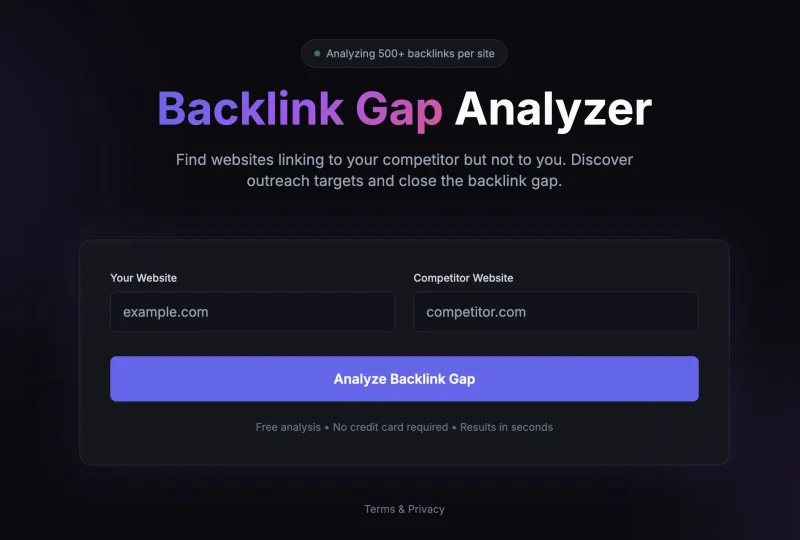
linkgap.io is a backlink gap analyzer. You paste in your website and a competitor’s website, click one button, and it shows you which sites link to them but not to you. I built it as a lead magnet — I wanted to give people who can’t afford $150+/month for Semrush or Ahrefs access to one useful slice of that data, and in exchange I capture an email address. That’s the trade and I’ve never hidden it.
It took about four hours. I vibe coded it with Claude Code. The backlink data comes from DataForSEO, which is the same underlying source several of the big commercial tools draw from, so the output is genuinely comparable to what you’d pay for.
I did not think about search rankings once during the build. I actively removed text because I wanted a clean lead magnet. I never added a meta description because it didn’t occur to me. I’m reverse-engineering this after the fact, and you should weight my conclusions accordingly.
Here’s what I’m measuring against:
- Timeframe: March 22, 2026 to August 10, 2026
- Ranking data: Semrush, plus manual SERP checks
- Usage data: the tool’s own run and lead logs (I have no site analytics)
- Backlink data: Semrush referring domains export for both my site and the incumbent’s
- Control: an established competing tool in the identical query space, which I’ll describe but not name
Finding 1: The site is missing every item on the technical SEO checklist
Does a page need a meta description, schema, or H2 tags to rank on Google? Based on this site: no.
Here’s the exact state of the page.
What’s on it:
| Element | Value |
|---|---|
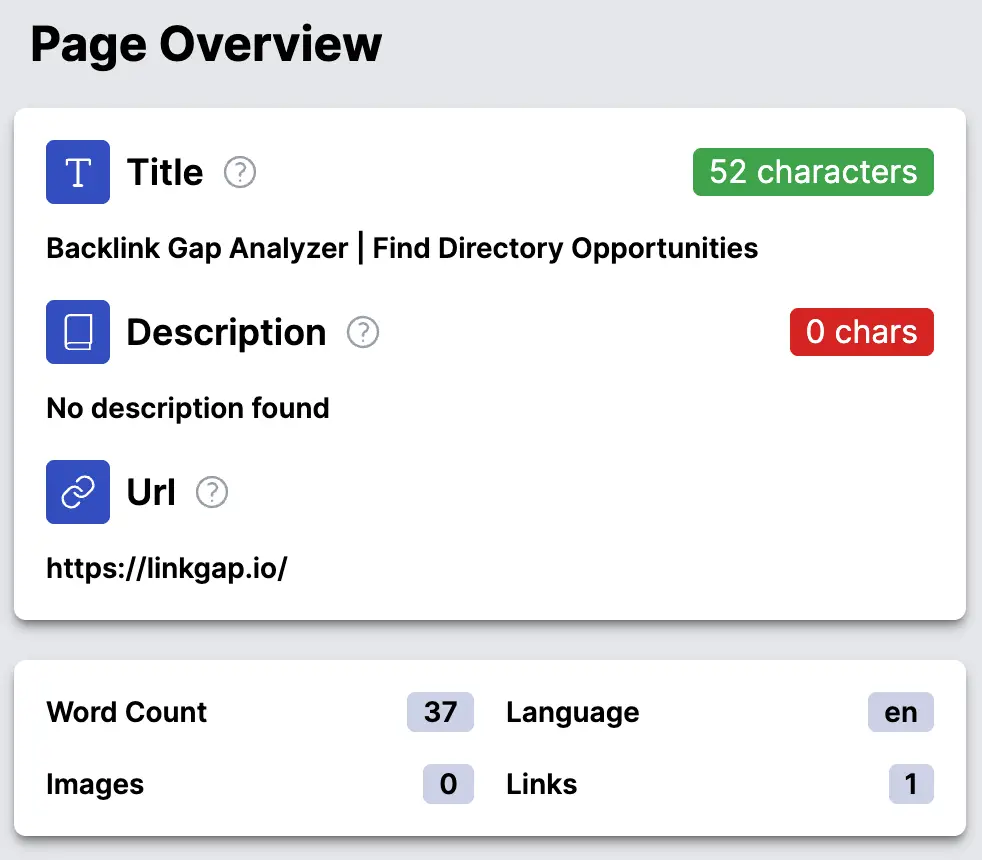
| Title tag | Backlink Gap Analyzer | Find directory opportunities (auto-written by Claude Code) |
| H1 | Backlink Gap Analyzer |
| Body copy | One sentence: “Find websites linking to your competitor but not to you. Discover outreach targets and close the backlink gap.” |
| Interactive elements | Two input fields, one button |
| Total word count | ~35 words |
What isn’t on it: no meta description, no H2 tags or subheadings of any kind, no schema markup, no sitemap, no robots.txt that I’m aware of, no favicon, no Google Search Console connection, no analytics, no blog or supporting content, no internal links, and no link building — ever.
The results as of August 2026:
| Keyword | Volume | KD | Position |
|---|---|---|---|
| backlink gap analysis | 880 | 21 | 1 |
| backlink gap tool | 590 | 28 | 2 |
| linkgap | 170 | 36 | 1 |
| backlink gap | 140 | 26 | 2 |
| what is backlink gap analysis | 110 | 27 | 1 |
| how to find backlink gap | 90 | 17 | 2 |
| linkgap io | 90 | 16 | 1 |
| competitor backlink gap analysis | 90 | 26 | 3 |
| what is a backlink gap tool | 70 | 13 | 1 |
| provide backlink gap analysis | 70 | 10 | 1 |
| backlink gap analyzer | 50 | 15 | 1 |
| link gap analysis | 50 | 22 | 1 |
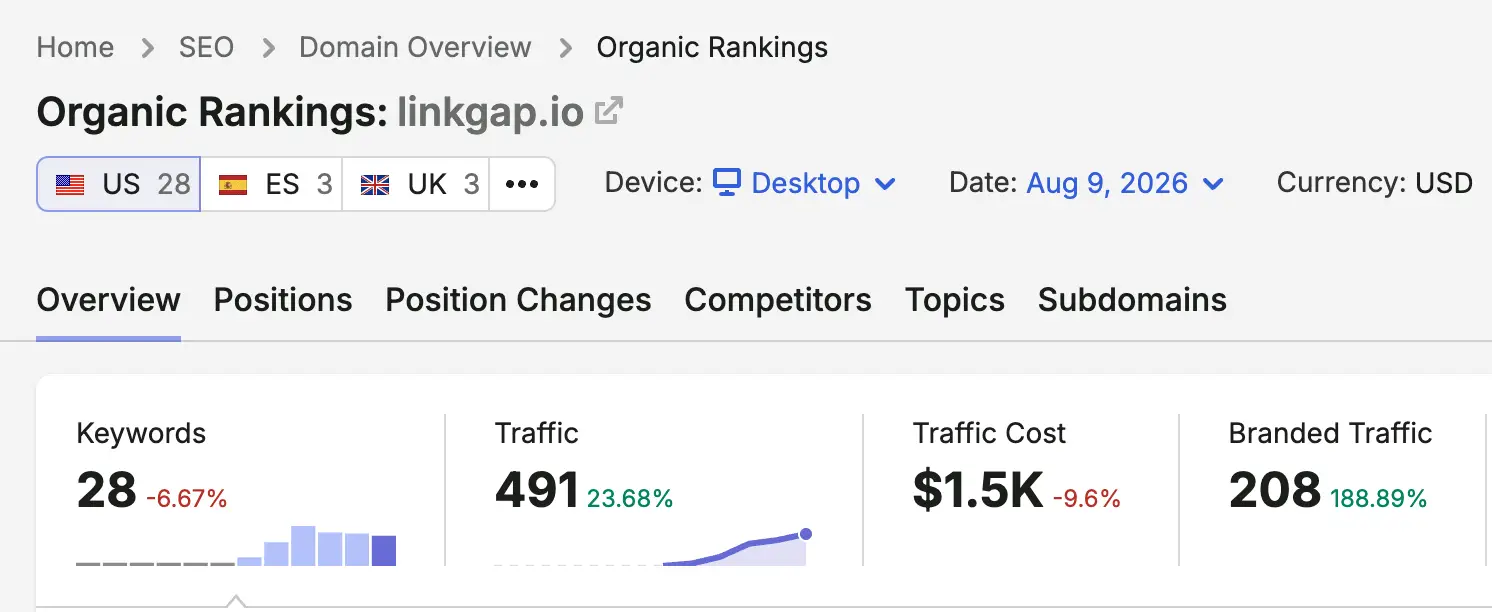
Three of those 28 positions are junk and I’m removing them from my own argument: “where is the nearest gap” (position 27), “where is the closest gap” (position 30), and “spidergap” (position 61). Nonsense matches. If I counted those in the headline number while knowing they were meaningless, you shouldn’t trust my other numbers either.
Finding 2: It ranked in two weeks, not six months
How long does a new site take to rank? The consensus answer is three to six months. This one took roughly fourteen days.
The timeline is unusually clean because the site’s launch and its promotion happened on the same day.
- March 22, 2026 — tool goes live, first social post the same day
- ~April 5, 2026 — I search the term on a whim and find the site on page one, top three
- August 2026 — 28 organic positions, #1 on the primary commercial term
My honest reaction in April was what the hell. I hadn’t optimized for that keyword. I only checked because it occurred to me to check.
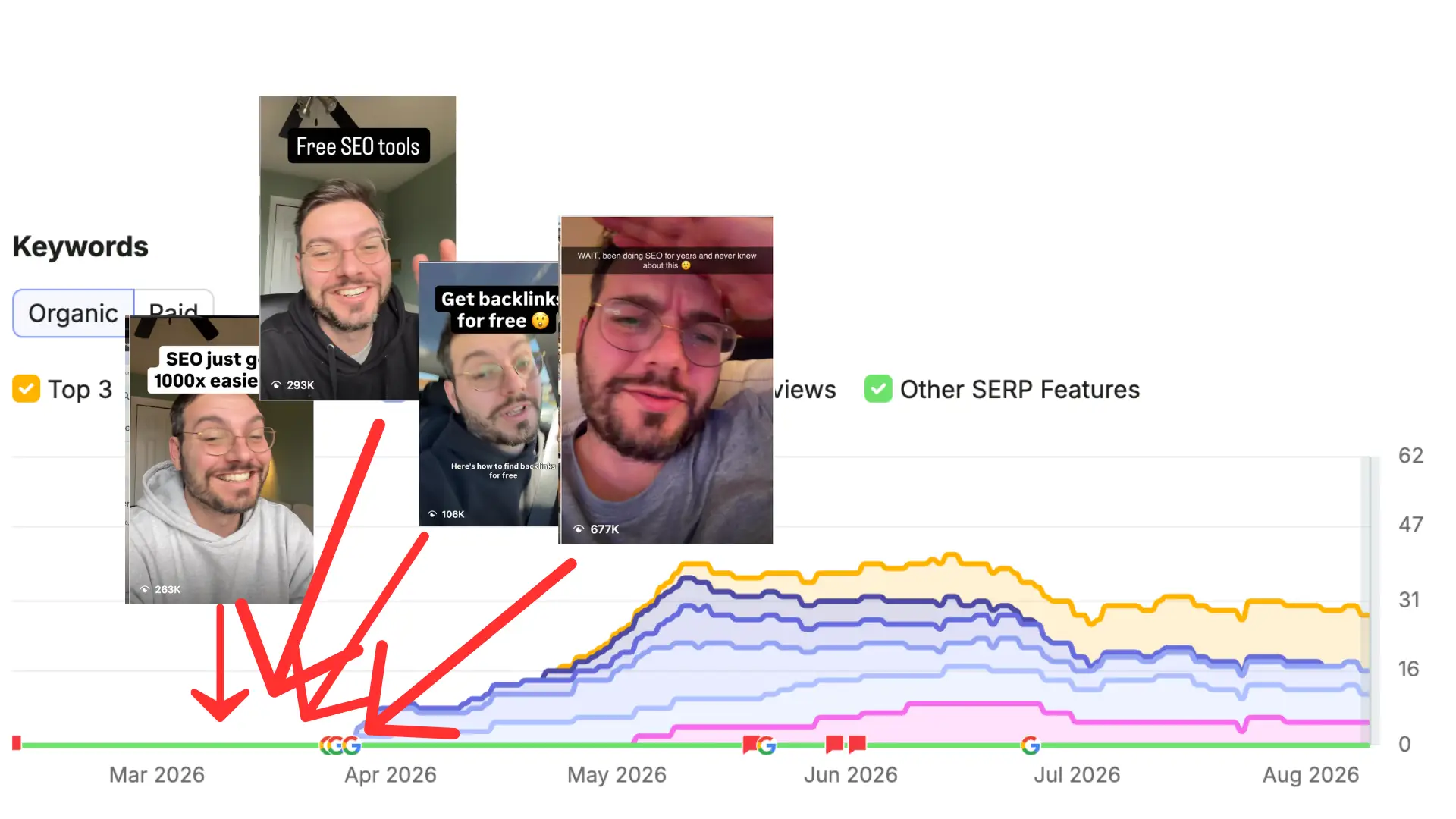
Branded search went from zero to 170/mo. At launch, “linkgap” had no search volume because the thing didn’t exist. It now does 170 searches a month. That’s demand created somewhere other than Google, which Google is now servicing.
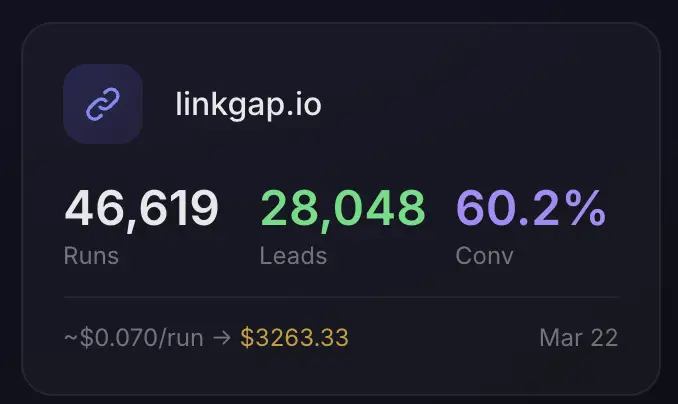
Here’s the usage data over that period, straight from the tool’s own logs:
- 46,410 runs
- 27,925 leads captured
- 60.2% conversion rate
- $3,248.21 in total data costs
Two precisions, because both will get poked at and they should:
That 60.2% is leads per run, not per visitor. Anyone who landed and left without running the tool isn’t in the denominator. With no analytics, I don’t know the visitor-to-lead rate. It’s lower than 60%.
46,410 runs against 27,925 unique people means roughly 18,500 repeat runs. People came back. That’s the most interesting number here and one of the very few behaviours in this story I can evidence rather than infer.
Finding 3: Backlinks didn’t do this — my best link is my own website
Can you rank without backlinks? This site effectively has none, and it ranks #1.
linkgap.io has 16 referring domains and 29 total backlinks.
Nine of those 16 domains sit on a single IP address in Moldova (195.20.19.178). That’s not sixteen sites linking to me. That’s one auto-generated spam network plus seven other things.
The median authority score across all 16 domains is 5.
My highest-authority backlink is from heytony.ca — my own website. Authority score 29. That is the best link pointing at this domain.
Strip out the spam network, my own site, and an obvious scraper directory, and I’m left with roughly three genuinely editorial links.
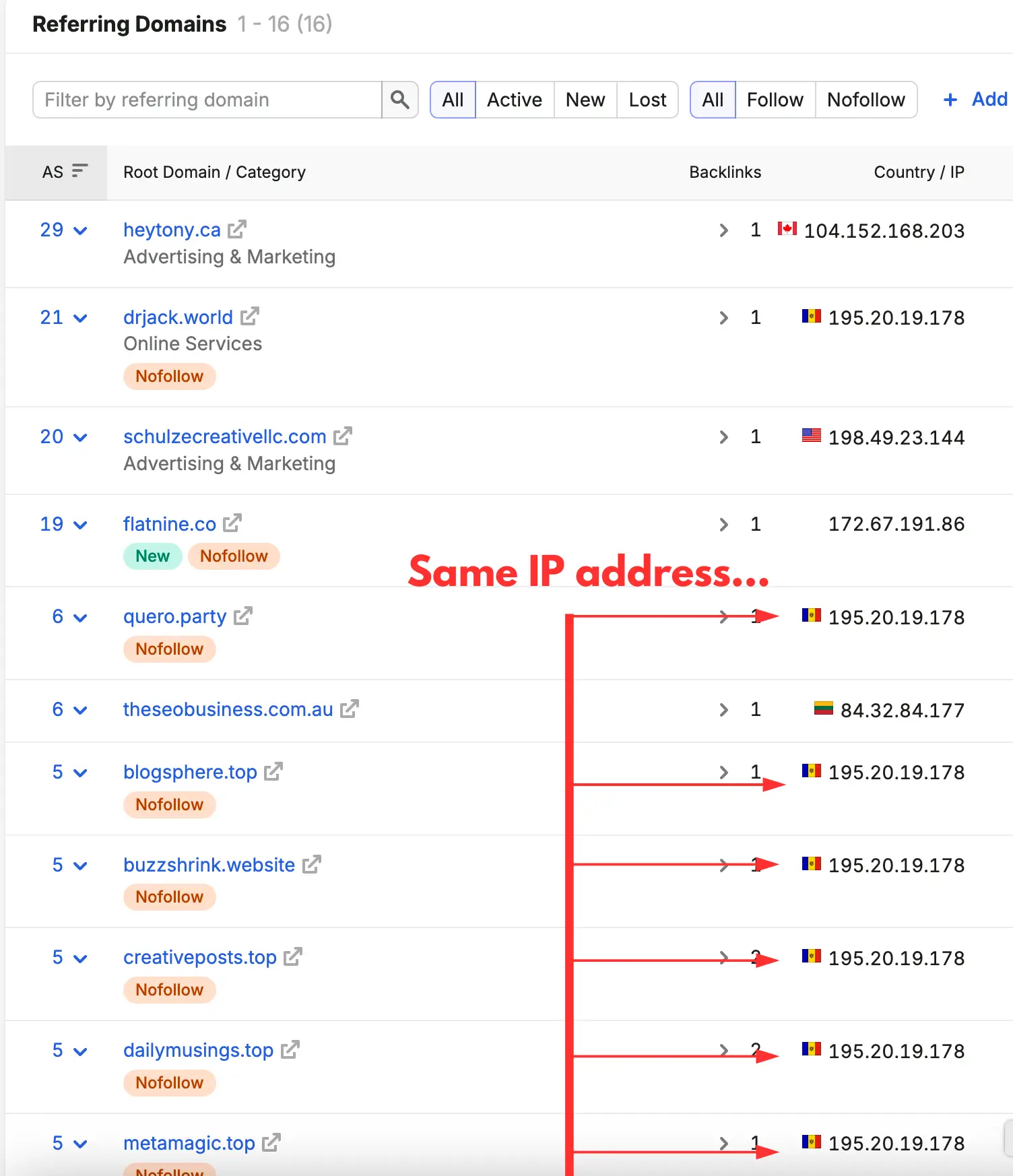
To be clear about what this does and doesn’t say: backlinks obviously still work, and for most businesses local backlinks are still worth building. What this shows is that they are not required — a page with no meaningful link equity can take a commercial term from a site with vastly more.
Finding 4: A spam network hit the site and nothing happened
Should you disavow spam backlinks? I didn’t, and it made no observable difference.
Nine spam domains from one Moldovan IP started pointing at a four-month-old site in May. Standard advice is to disavow immediately, and there’s an entire product category built on selling you that service.
I did nothing. The site ranks #1.
I don’t disavow links, and I never have. A link that looks spammy to you might be doing more good than harm, and you have no way to find out, because you cannot A/B test your own backlink profile. The toxic-link audit is one of the most reliably sold and least reliably useful products in this industry, and this site is one small piece of evidence against it.
There’s a detail here that matters for the next section: the same Moldovan network also links to my competitor. 15 backlinks to them, 9 domains to me. Whatever that spam is doing, it’s doing it to both of us, which eliminates it as an explanation for the difference between our rankings.
Finding 5: The exact-match domain theory doesn’t survive the comparison
Do exact-match domains still work in 2026? Not as an explanation for this.
There’s an incumbent in this space — a free backlink gap tool that’s been online for years. I’m not naming or linking it, because I have no interest in sending them traffic or making this personal. But the comparison is the most useful data in this article.
| linkgap.io | The incumbent | |
|---|---|---|
| Age | ~4 months | 3.5+ years |
| Referring domains | 16 | 168 |
| Total backlinks | 29 | 372 |
| Notable links | none | Yahoo (AS 100), Bing (92), Semrush (90), Hunter.io (54) |
| Title tag | auto-generated | properly written |
| Meta description | none | present |
| Open Graph tags | none | complete |
| Organic keywords | 28 | 43 |
| Traffic trend | climbing | declining |
| Position on primary term | 1 | below |
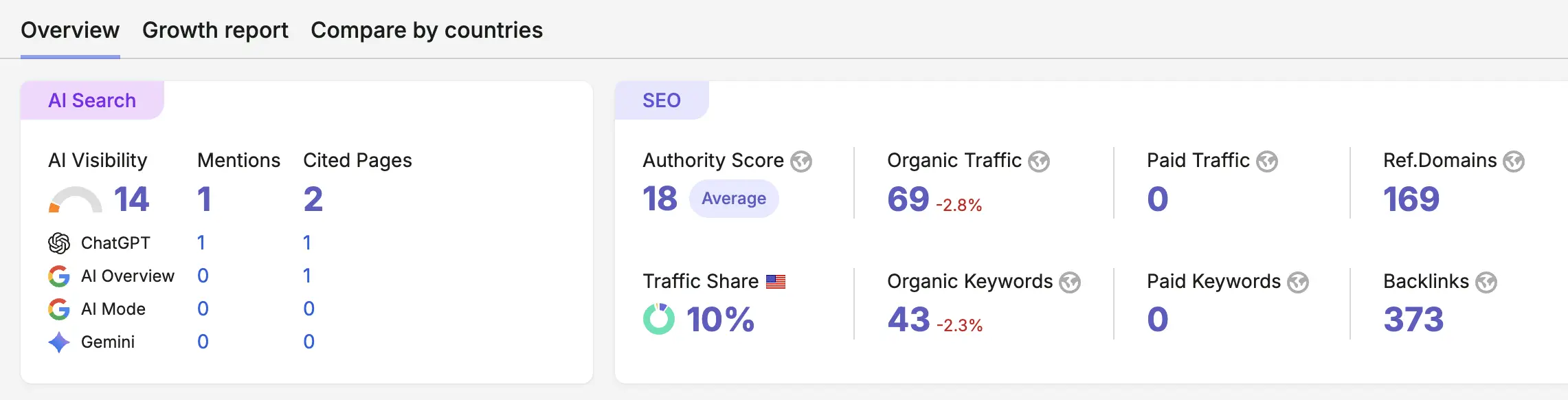
Their domain is a closer match to “backlink gap analysis” than mine is. Mine doesn’t contain the word “backlink” at all. Theirs does. They also have the older domain, the better link profile, and the proper on-page work. They lose the primary term anyway.
Now let me be fair to them, because the honest version of this comparison is the only one worth publishing. They beat me on total keyword count, 43 to 28. They have more total organic traffic. And their link profile, while much bigger, is also mostly garbage: median authority score 2, only seven domains above 30, and their own 28-domain spam cluster on a single IP.
So the accurate claim is not “I crushed them.” It’s this: they have roughly seven real links, three and a half years of history, and proper on-page SEO. I have one real link and four months. I take #1 on the primary commercial term.
Their traffic is falling. Mine is climbing. Same query space, same spam network hitting both, opposite trajectories.
Finding 6: The thing I can’t rule out, and neither can you
Does this generalize? No — and this is the strongest argument against everything above.
I have roughly 854,000 followers across five platforms:
| Platform | Followers |
|---|---|
| 390,000 | |
| 345,000 | |
| TikTok | 74,000 |
| Threads | 24,000 |
| YouTube | 21,000 |
That audience is heavily concentrated in people who care about SEO. It is a distribution advantage almost nobody reading this has.
Could a stranger with no audience put up the identical page tomorrow and get the same result? No. I think it would sit there and do nothing.
Here are all the confounds, listed rather than buried:
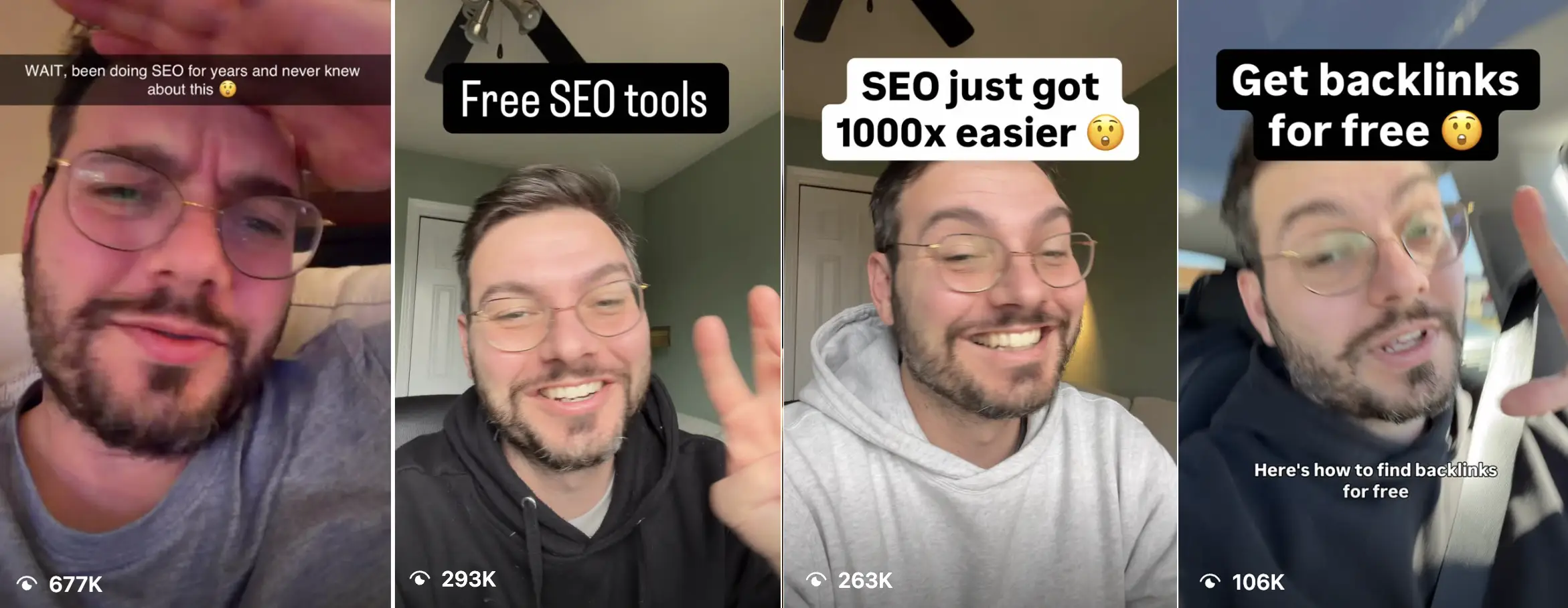
- Roughly 10 social posts over a couple of months. Individual videos at 677k, 293k, 263k, and 106k views.
- An appearance on Edward Sturm’s podcast discussing the tool and the results — small, 5–6k views, but it exists.
- A handful of smaller accounts picked up the tool and posted about it.
- I linked to it from heytony.ca, which has real topical authority in the SEO space.
- I did not send it to my email list. It’s a top-of-funnel magnet and my list is mid-funnel, so it never went out.
It’s also entirely possible Google is picking up on social captions, podcast transcripts, or general conversational signal about the tool. I can’t rule that out either. That might be a separate theory worth testing on its own.
My hypothesis, clearly labelled as a hypothesis
Everything above this line is data. Everything below it is inference, and I’m marking it that way on purpose.
What I think happened: people came to the site, completed the task they came for, and Google observed that behaviour — and the observed behaviour did the job technical SEO is supposed to do.
The chain as I’d draw it:
- Someone sees the tool in a video on Instagram, Facebook, or TikTok.
- Those platforms don’t allow clickable links in the content, so they type linkgap.io into their browser manually. That’s not a clever design choice — it’s a constraint of where my audience lives. 86% of my following is on the two Meta platforms.
- They land, paste in two URLs, click the button.
- They wait 30–60 seconds while the analysis runs.
- They land on a report page at a unique URL — a second page load in the same session.
- They get what they came for. They don’t return to the search results and click the next thing.
- A meaningful share come back later and run it again — roughly 18,500 repeat runs.
- Branded search for “linkgap” goes from zero to 170/mo.
The step I’d point at hardest is number 6: people not going back to the SERP to click a competitor.
Where the evidence stops and my guessing starts
Google has publicly denied using click and engagement data as direct ranking factors for years — former head of web spam Matt Cutts and others repeatedly argued that click-through rate was too noisy and too easily manipulated to use in ranking.
Two things have since complicated that position.
The first is sworn testimony in the US v. Google antitrust trial. Google VP of Search Pandu Nayak testified in October 2023 about an internal system called Navboost, describing it as one of the important signals Google has — a system built on a rolling 13-month window of aggregated user click data, in operation since roughly 2005. Its companion system, Glue, handles everything else on the page; Nayak described Glue as another name for Navboost covering the rest of the page’s features, aggregating clicks, hovers, scrolls and swipes. Fuller breakdown of the trial testimony here.
The second is the Google Content Warehouse API leak of May 2024. Roughly 2,500 pages of internal documentation and over 14,000 attributes were accidentally published to a public GitHub repository, passed to Rand Fishkin of SparkToro, and analyzed in depth by Mike King at iPullRank. Among the field names: goodClicks, badClicks, lastLongestClicks, siteAuthority, and a module called chromeInTotal. Google’s response was that the documentation lacks context — not that it was fake.
That material establishes that user interaction data exists inside Google’s systems and is used somewhere in ranking. It does not establish that Google observes on-page button clicks, or that Chrome browsing data flows into search ranking in the way I’m describing. I believe it probably does. I can’t show you that it does. That belief is mine, not a finding.
One claim I’ve made before and am now dropping: I used to argue that local clients with Google Analytics installed are handing Google conversion data it can use for ranking. That isn’t established, Google has consistently denied it, and no leak or testimony supports it. What I actually mean is that better-converting sites tend to produce observable search behaviour, which is a different and far more defensible claim.
What this proves and what it doesn’t
It proves: there is no one way to do SEO that guarantees a ranking. The standard technical checklist is neither necessary nor sufficient. A site can violate essentially all of it and still take the top spot on a commercial term, above an older, better-linked, properly-optimized competitor. One counterexample is enough to kill a universal rule, and this is one.
It does not prove: that you should stop doing traditional SEO. That links don’t matter. That on-page work is worthless. That this replicates for anyone else. That I know what Google is doing internally.
This is one site, one niche, one query cluster, four months, no control group, and a distribution advantage most people don’t have.
Where traditional SEO still matters, in my actual opinion: most of it, for most businesses. Heading hierarchy isn’t only a ranking thing — it’s how screen readers navigate a page and how someone with a visual impairment finds where the next section starts. Content still has to be good. Technical work still stops you shooting yourself in the foot.
But all of it sits downstream of one question: which site do people prefer using? SEO is people looking for a solution to a problem — informational, product, or service. If you’re the one who solves it most simply and most plainly, that’s how you win.
What to do this week
- Open your most important money page and time yourself. How many seconds until a visitor can take the action they came for? If it’s more than a few, that’s your first fix.
- Make the primary action impossible to miss. Bigger button, clearer offer, fewer competing choices on the page.
- Check whether people are bouncing back to Google after landing. If you have Search Console, look for high impressions and weak clicks on terms you rank for — that’s the signal you’re getting picked and then rejected.
- Build one genuinely useful free thing and put it where your audience already is, even if you can’t include a link. Constraint isn’t always a problem.
- Stop paying for toxic-link audits and disavow files unless you’ve received a manual action. Spend that money on the page instead.
- Add one fact from your own business that nobody else on the internet has. Your own numbers, your own timelines, your own results — it’s the one thing a bigger competitor can’t copy.
- Run one experiment you can publish. Not a tip you read. Something you actually tested, with the numbers that didn’t flatter you left in.
Want a starting point? Run your site through my free AI readiness checker, or use linkgap.io — the site this entire article is about.
Keeping this honest: my prediction and my falsifier
I’d rather commit to these publicly than quietly adjust them later.
What I will not do to the site: anything. No meta description, no schema, no H2s, no sitemap, no Search Console, no link building. I’ll keep making videos and sending people there, because that’s what a lead magnet is for, but the page stays broken.
I’m leaving the spam links in place. No disavow.
My 90-day prediction: position 1 or 2 for “backlink gap analysis,” barring a flag or someone genuinely doing it better.
What would make me say I was wrong: if a site doing all the traditional things correctly, without a large social audience behind it, comes along and outranks me quickly. That would tell me the conventional playbook was doing the work all along and I’d been reading the wrong variable.
What would strengthen it: another tool with no SEO but a big social push ranking the same way — different owner, different niche, same shape.
The next experiment: build the identical tool under a different name. Same process, same lack of optimization, same social distribution. If it ranks, the mechanism travels. If it doesn’t, this was a fluke and I’ll say so here.
FAQ
Can you rank on Google without doing SEO? You can rank without doing the technical SEO checklist — this site has no meta description, no sitemap, no schema, no H2 tags, and no Search Console connection, and it ranks #1 for an 880/mo commercial term. But it didn’t rank without anything. It had 27,925 people using it. Substitute distribution for optimization and you may still need one of the two.
Do you need a meta description to rank? No. Meta descriptions have not been a ranking factor for years — they influence click-through from the SERP, which is a different thing. This page has never had one and holds 28 organic positions.
Do you need a sitemap to be indexed? No. Sitemaps help Google discover pages on large or poorly linked sites. A single-page site with inbound traffic gets found regardless. This one has no sitemap and was indexed within two weeks.
Do you need Google Search Console to rank? No. Search Console is a reporting tool, not a ranking input. Connecting it tells you what’s happening; it doesn’t change what happens. This site has never been connected.
Does Google Analytics data affect rankings? There’s no established evidence that it does, and Google has consistently denied it. I’ve argued the opposite in the past and I’m retracting that here.
Can you rank without backlinks? This site has 16 referring domains, nine of which are one spam network, and its highest-authority link is from my own website. Roughly three links are genuinely editorial. So: with almost none, on a low-difficulty commercial term, yes.
Should you disavow spam backlinks? Unless you’ve received a manual action, probably not. Nine spam domains from a single Moldovan IP started pointing at this site in May, I did nothing, and it ranks #1. You cannot A/B test your own link profile, which means you can’t actually know whether a link you removed was helping.
Does an exact-match domain guarantee a ranking? No. A competing tool with a closer exact match, an older domain, and 10x the referring domains is being outranked on the primary term by linkgap.io.
How long should a new site take to rank? The consensus is three to six months, and for most sites that’s right. This one placed in the top three within about two weeks, with substantial direct traffic driving it from day one.
Does thin content rank? It can, when the page is the answer. 35 words is thin by any definition, but the page is a working tool that resolves the query completely. Word count isn’t the variable — task completion is.
Does this mean I should stop doing technical SEO? No. It means the checklist isn’t a formula. Do the fundamentals, then spend your remaining effort on whether people can actually accomplish what they came for.
This is one site, tested over four months from March to August 2026. I’ll re-check it at 90 days and publish what changed — including if it drops.
linkgap.io is free. It’ll stay free. It also has no meta description, and I’m leaving it that way.
Originally published . Last updated .
Categories:

Explore More